
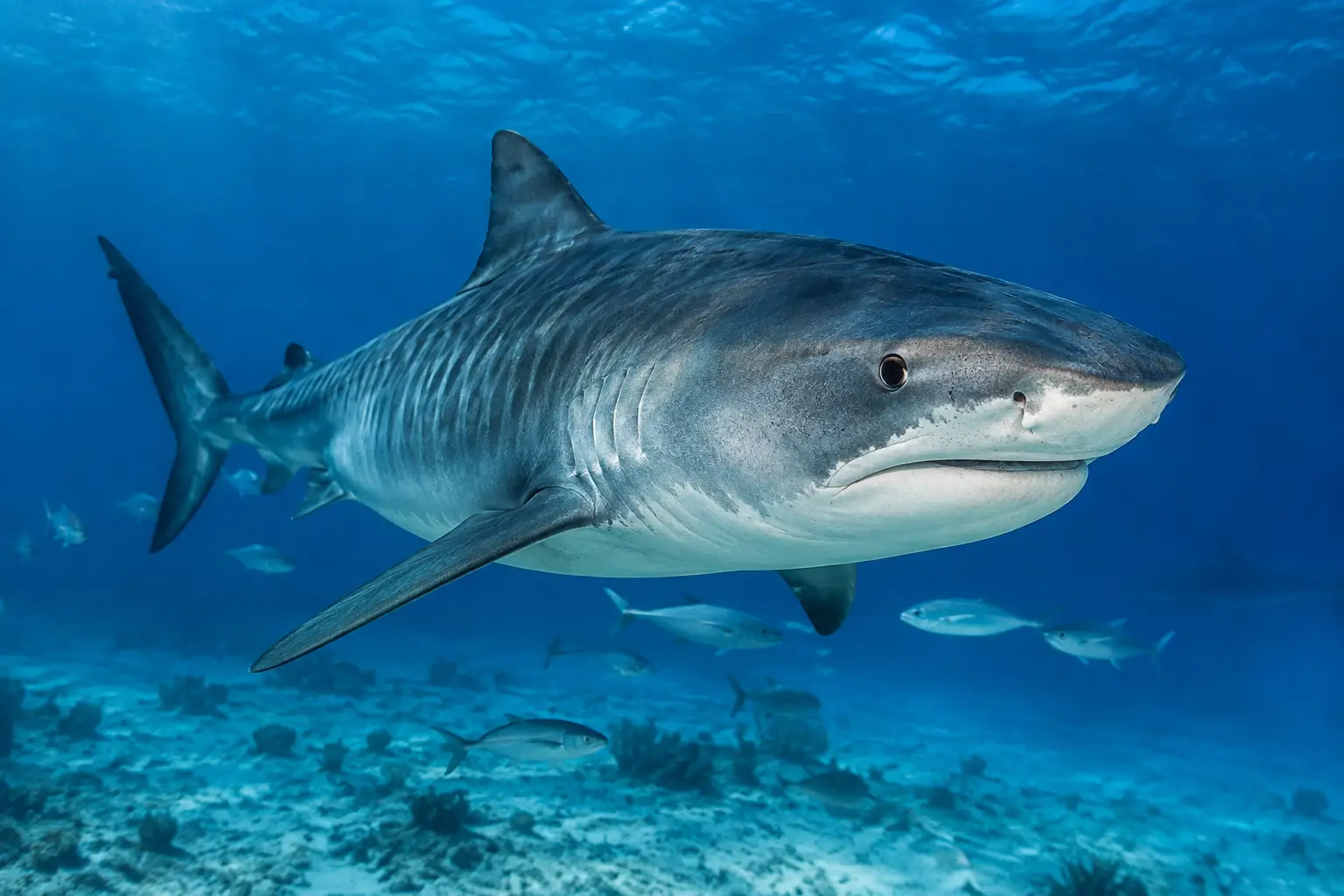
A tiger shark does not need to rush to command attention. Its broad head, long tail, and unmistakable striped flanks create a presence that changes the mood of a dive before it comes close. For many experienced divers, seeing one is a bucket-list encounter. For any diver, it is also a reminder that the ocean is wildlife habitat first.
The right response is not fear, and it is not casual confidence. It is informed respect. Understanding how tiger sharks move, feed, and respond to their surroundings helps divers make better choices underwater while appreciating one of the ocean’s most capable predators.
Why the tiger shark has such a powerful reputation
Tiger sharks, Galeocerdo cuvier, are large requiem sharks found in tropical and subtropical waters around the world. Adults can exceed 12 feet, with exceptional individuals growing substantially larger. Young sharks often display dark vertical bars along their sides, giving the species its name. Those markings tend to fade as the shark matures, although the pattern remains visible on many animals.
Their reputation comes partly from size and partly from diet. Tiger sharks are generalist feeders. Fish, rays, seabirds, sea turtles, crustaceans, and carrion can all be part of their natural diet. Their jaws and heavily serrated teeth are built to handle a wide variety of prey, including hard-shelled animals.
That versatility does not mean a tiger shark views a diver as prey. Sharks do not move through the ocean looking for human encounters. Still, a large, curious animal deserves calm awareness and disciplined behavior. Treating any shark encounter as a photo opportunity first, rather than a wildlife interaction, is where poor decisions begin.
Where divers may encounter tiger sharks
Tiger sharks spend time in coastal and offshore habitats, including reef edges, channels, lagoons, sandy drop-offs, and deeper open water. They are highly mobile and can travel long distances, so sightings can be seasonal and conditions can change quickly. A site known for tiger sharks one month may offer no encounters the next.
Warm water, healthy reef systems, and areas with reliable food sources can all influence where they appear. In Fiji, shark encounters are shaped by currents, visibility, water temperature, local marine life, and the management practices of individual dive sites. No responsible operator should promise a specific species on a particular day. Wildlife does not follow a schedule.
This unpredictability is part of what makes a genuine encounter so memorable. A tiger shark passing through blue water is not performing for divers. It is simply moving through its environment, and divers are privileged observers.
Reading tiger shark behavior underwater
A relaxed shark generally moves with measured, purposeful motion. It may pass at a comfortable distance, circle widely, or investigate an unfamiliar shape in the water. Curiosity is normal shark behavior. It should not be confused with aggression, but it should always be met with good situational awareness.
Watch the whole animal rather than focusing only on its head. Direction changes, body posture, tail movement, and the shark’s distance from you all provide useful context. A shark that is cruising steadily and giving divers space presents a very different picture from one that is repeatedly approaching closely, moving erratically, or showing obvious signs of agitation.
Divers should also read the wider environment. Are there baitfish moving nervously? Is current increasing? Is another large animal entering the area? Is your group spreading out? The safest observations happen when divers remain aware of the full scene rather than becoming absorbed in a camera screen.
Distance is a safety tool, not a missed opportunity
Give a tiger shark room to choose its own path. Do not chase it, block its direction of travel, reach toward it, or position yourself directly above it. Keep your body vertical or slightly head-up when practical, maintain steady breathing, and make controlled movements.
If the shark approaches, hold your position unless your guide directs otherwise. Sudden finning, splashing, and frantic retreats can create confusion within a group. A composed diver is easier for the guide to manage and better able to enjoy the moment.
Good underwater images come from patience, positioning, and respect for the animal’s space. A wide-angle photograph that shows the shark moving naturally through its habitat often tells a far better story than a close frame created by crowding it.
How to prepare for a shark-focused dive
Preparation starts well before the descent. Shark diving is not necessarily only for highly advanced divers, but the appropriate experience level depends on the site, depth, current, and dive plan. A diver who is comfortable with buoyancy, ear equalization, mask clearing, and controlled ascents can focus on the encounter instead of managing basic skills under pressure.
Listen carefully to the briefing. A professional briefing should cover entry and exit procedures, depth limits, hand signals, group positioning, current expectations, camera etiquette, and the specific behavior required around marine life. If anything is unclear, ask before entering the water. Questions are a sign of good judgment.
Equipment should be streamlined and familiar. Secure hoses, clips, and gauges. Check that cameras, lights, and accessories will not swing into other divers or distract you from buoyancy control. Avoid wearing reflective objects that may flash in sunlight. Most importantly, never bring food into the water or attempt to feed wildlife independently.
For divers who feel excited and slightly nervous, that is a healthy place to begin. The best next step is to choose an operation with experienced guides, clear procedures, sensible group sizes, and a culture that puts diver behavior ahead of spectacle.
The difference between managed encounters and reckless interactions
Not all shark encounters are created equal. A carefully managed shark dive can create exceptional viewing opportunities while maintaining strict rules around positioning, supervision, and animal welfare. An unmanaged interaction, particularly one involving divers who ignore guidance or try to provoke a reaction, carries needless risk for people and sharks.
Responsible operations plan for the realities of large-animal diving. They assess conditions, establish boundaries, brief guests clearly, and have the authority to cancel or adjust a dive when conditions are not right. That judgment may feel disappointing on the surface, but it is part of what makes a premium wildlife experience worth trusting.
There are trade-offs in every close wildlife encounter. The closer the interaction appears, the more important it is to ask how that proximity was achieved. Ethical diving prioritizes natural behavior over forced moments. It also recognizes that conservation is not a backdrop for adventure. It is the reason these animals and their habitats remain worth visiting.
Why tiger sharks matter to reef ecosystems
Large sharks help shape marine ecosystems through their role as upper-level predators and scavengers. Tiger sharks can influence where prey species feed and travel, while also removing weakened or dead animals from the system. Scientists are still studying the full ecological role of sharks across different regions, but their loss is widely associated with imbalance in marine food webs.
Tiger sharks also face real pressures. Fishing mortality, bycatch, demand for shark products, and habitat degradation affect populations in many parts of their range. Because sharks generally grow slowly and produce relatively few young compared with many fish species, population recovery can take time.
That makes diver choices meaningful. Support operators that follow wildlife protocols, respect local regulations, reduce waste, and invest in marine protection. Share images that show sharks as powerful, valuable animals rather than monsters. The stories divers bring home can influence how friends, families, and future travelers see the ocean.
A better kind of bucket-list encounter
A tiger shark encounter should leave a diver with more than an adrenaline spike. It should sharpen your awareness of the ocean’s complexity: a powerful animal moving with remarkable control, a reef system supporting life at every scale, and a human responsibility to observe without taking too much.
At Coral Coast Divers, that perspective is central to shark diving in Fiji. World-class encounters are strongest when they are guided by professional standards, careful planning, and genuine respect for the animals that make the experience possible.
If you hope to see a tiger shark, arrive ready, listen closely, and let the animal set the terms of the moment. The most memorable encounter is not the one where you get closest. It is the one where you leave the water more capable, more humbled, and more committed to protecting what you came to see.