A damaged reef does not recover because a diver plants one coral fragment and takes a photo. Real recovery is slower, more technical, and far more rewarding. The best coral restoration diving examples show how recreational divers, marine scientists, and responsible operators can contribute to living reef systems while respecting the work required to keep them healthy.
For visitors to Fiji, conservation diving can add genuine purpose to an already extraordinary underwater trip. It may mean handling coral only under direct instruction, helping monitor a restoration site, or learning why a healthy reef needs more than newly planted coral. The goal is not to turn every diver into a marine biologist. It is to give divers a meaningful role in protecting the places they have come to experience.
What Coral Restoration Diving Actually Involves
Coral restoration is the active support of reef recovery where natural regeneration is limited or too slow. Depending on the site, that can involve growing coral fragments in a nursery, securing healthy fragments to degraded substrate, stabilizing loose rubble, removing invasive organisms, or collecting monitoring data over time.
It is not a substitute for reducing the pressures that damaged the reef in the first place. Sediment, pollution, destructive fishing, anchor damage, coral disease, and warming water can overwhelm even the best restoration project. A well-run program therefore combines hands-on work with reef protection, education, site management, and long-term measurement.
For divers, the distinction matters. A coral planting activity can be memorable, but it should be part of a documented project with trained oversight, appropriate species selection, and a plan for maintaining the site. Otherwise, a well-intended experience can create more disturbance than benefit.
Coral Restoration Diving Examples in Action
Coral nurseries that grow fragments before outplanting
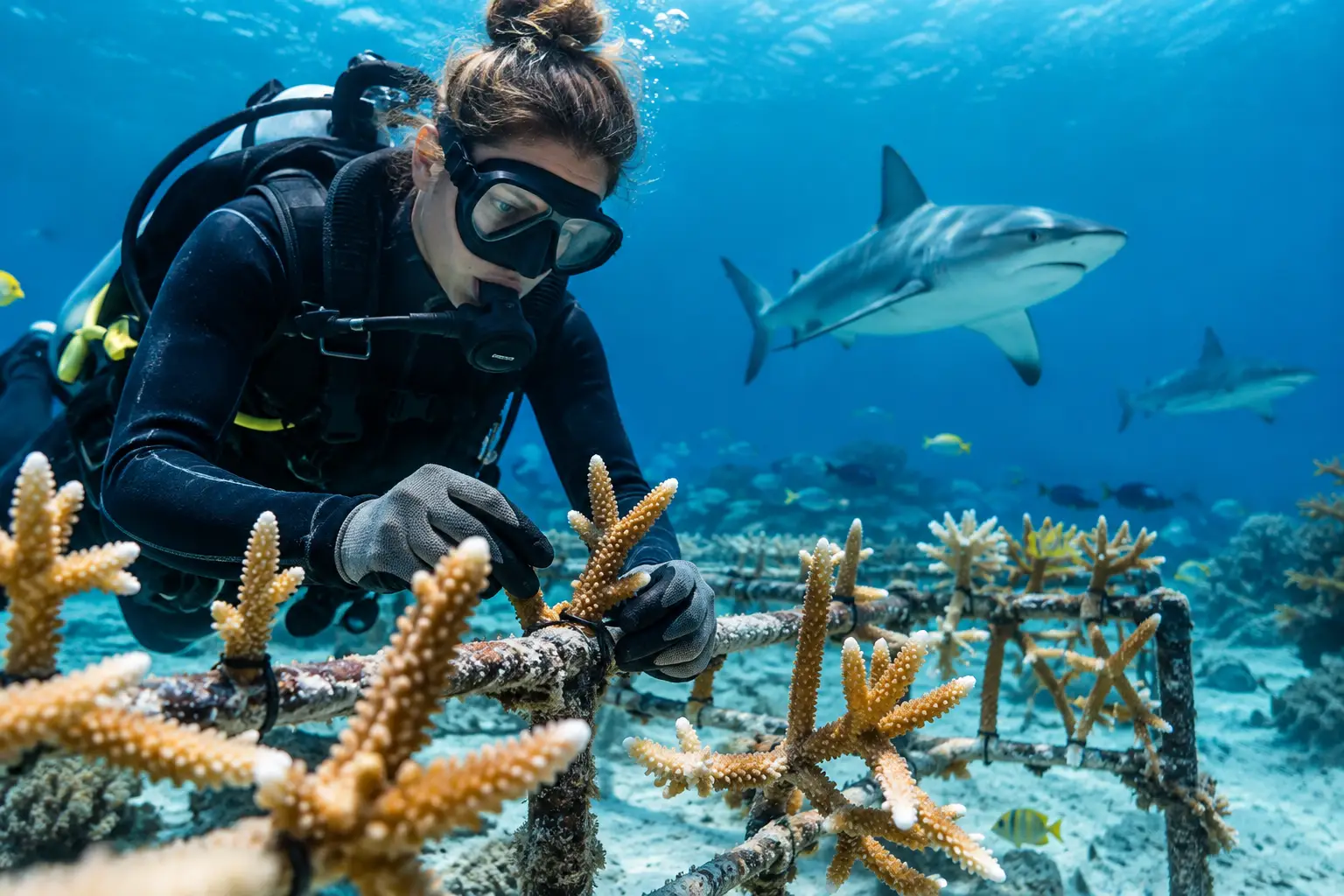
One of the most recognizable examples is the coral nursery. Divers may see fragments of branching coral attached to underwater trees, suspended lines, tables, or carefully designed frames. These nurseries keep fragments elevated above sediment and positioned for suitable water flow and light while they grow.
Fragments are often collected from healthy donor colonies without removing excessive material from any one coral. Over time, trained teams clean algae from nursery structures, check attachment points, document growth, and watch for disease or predation. Once fragments reach the right size, they can be moved to a prepared reef site.
The appeal is obvious: divers can see a living nursery develop across repeat visits. The trade-off is that nurseries require ongoing maintenance. A structure left unattended after storms, strong currents, or algae growth is not restoration. It is underwater debris.
Outplanting coral on suitable reef substrate
Outplanting is the step most people picture when they think of restoration diving. A trained team secures nursery-grown or naturally broken fragments to stable rock or dead coral substrate using marine-safe methods appropriate to the site. The fragment must be placed at the correct depth, orientation, spacing, and water-flow zone for that coral species.
A branching coral that thrives in shallow, high-energy water may fail in a deeper, sheltered location. Likewise, placing fragments too closely together can increase competition or disease transmission. Successful outplanting is not simply about adding the greatest number of corals. It is about putting the right coral in the right place and returning regularly to assess survival.
Recreational divers can sometimes assist with supervised outplanting, but only when they have excellent buoyancy control and follow the project leader’s process precisely. A misplaced fin, dangling gauge, or hurried attachment can damage both newly planted fragments and established reef life nearby.
Stabilizing rubble fields so young corals can settle
After severe storm damage or other physical disturbance, a reef can become a field of loose coral rubble. Coral larvae and small fragments struggle to establish themselves on material that shifts with every surge. In these conditions, restoration may begin with stabilizing the substrate rather than planting coral immediately.
Teams can use carefully designed frames, natural materials, or site-specific stabilization methods to create a more secure foundation. Over time, crustose coralline algae and naturally settling coral larvae may colonize the stable surface. This approach can be less dramatic than planting a fragment, but it addresses a fundamental obstacle to natural recovery.
It also illustrates a key principle of responsible restoration: the visible task is not always the most valuable one. Sometimes the best action is creating conditions in which the reef can rebuild itself.
Monitoring coral survival, fish life, and reef change
Some of the most useful conservation work does not involve touching coral at all. Divers can help gather repeat photographs, count indicator fish, measure coral growth, record bleaching, or document disease and predator activity. These observations give restoration teams the evidence needed to decide whether a method is working.
For example, a site with high fragment survival but low fish activity may need further investigation. A nursery producing fast-growing coral may still be unsuitable if outplanted fragments repeatedly fail during seasonal heat stress. Monitoring turns restoration from a good-looking activity into an adaptive management process.
This is particularly valuable for experienced divers, underwater photographers, and marine-minded travelers who enjoy returning to the same sites. Consistent images taken from designated points can reveal changes that casual observations miss.
Removing marine debris and preventing new damage
Marine debris removal is not the same as coral restoration, but it can be an essential supporting action. Fishing line, plastic, discarded equipment, and other debris can smother corals, entangle marine life, or abrade reef structures in moving water. Carefully planned cleanup dives can reduce immediate harm while providing useful information about where debris is coming from.
The emphasis should be on careful. Removing an object that has become part of a reef structure may cause more damage than leaving it until a trained team can assess the situation. Divers should never pull blindly on line caught in coral, reach into holes, or remove hazards without considering currents, marine life, and personal safety.
What Makes a Restoration Dive Responsible
A credible coral restoration experience starts with professional dive standards. Participants need appropriate certification, calm water skills, reliable equipment, and strong buoyancy control before working near fragile coral. In many cases, a conservation briefing and a skills check are more valuable than rushing into a hands-on task.
Ask whether the project identifies its target species, monitors survival, maintains its nursery or outplant sites, and works with local scientific or community partners. Good programs can explain why they selected a particular site and what success looks like beyond the number of fragments planted.
There are also times when divers should not handle coral. A beginner may contribute more by practicing non-contact buoyancy, collecting photo-monitoring data, or joining a guided reef education dive. Strong currents, poor visibility, active bleaching, or a stressed reef can make hands-on activities inappropriate. Responsible conservation is measured by outcomes, not by how much contact a visitor has with coral.
How Divers Can Make Their Impact Last
The most useful habit begins before any restoration activity: become a low-impact diver. Keep fins clear of the bottom, secure alternate air sources and instruments, maintain neutral buoyancy, and avoid resting hands on the reef. Good trim protects coral on every dive, not just designated conservation dives.
Choose operators that prioritize smaller groups, structured briefings, reef-safe practices, and meaningful conservation partnerships. Support marine protected areas, respect local rules, and be selective about what you share online. A compelling image should never encourage people to touch wildlife, stand on coral, or pursue a close encounter at the reef’s expense.
At Coral Coast Divers, conservation-minded guests can pair world-class Fiji diving with a deeper understanding of the reef systems that support sharks, fish, corals, and coastal communities. The strongest memories often come from realizing that the reef is not a backdrop for adventure. It is the living foundation of the entire experience.
The next time you see a coral fragment secured to a restoration frame, look beyond the single piece of coral. Consider the divers monitoring it, the protected habitat around it, the conditions it needs to survive, and the years required for a reef to become complex again. That perspective is where a conservation dive becomes a lasting commitment to the ocean.