
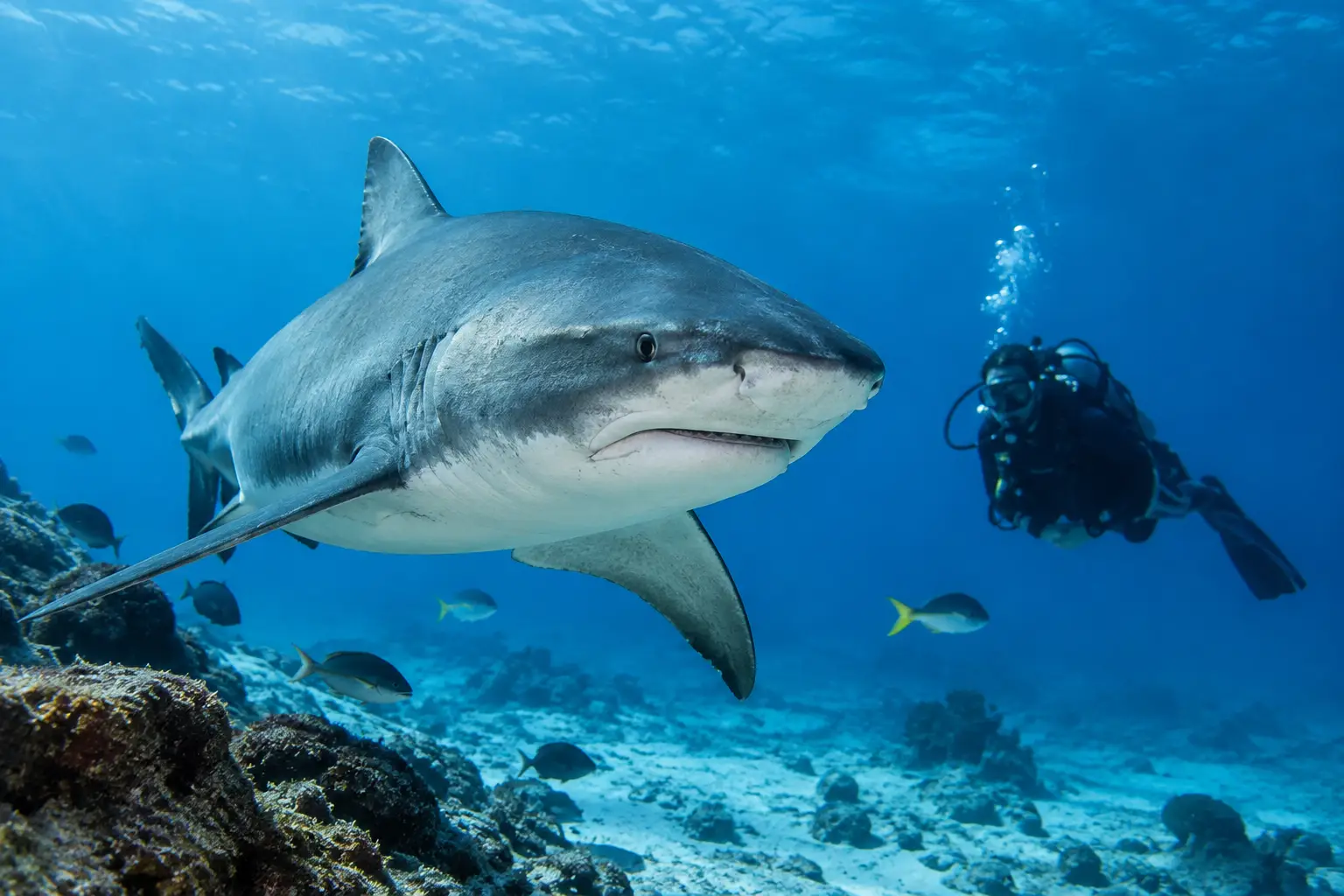
Bull sharks have a presence that changes the feel of a dive before they ever come fully into view. Their broad heads, powerful build, and unhurried movement command attention without needing speed or spectacle. For divers visiting Fiji, an encounter with this species can be one of the most memorable moments underwater – provided it is approached with respect, sound briefing procedures, and a clear understanding of shark behavior.
What Makes Bull Sharks So Remarkable?
Bull sharks are among the most recognizable large sharks in tropical and subtropical waters. They are named for their stout profile and blunt snout, not because they are constantly aggressive. Adults can grow well over seven feet long, with females generally reaching larger sizes than males, and their strength is obvious even when they are simply cruising through the water column.
One of their most unusual biological traits is their ability to tolerate freshwater. Unlike most sharks, bull sharks can regulate the salt concentration in their bodies well enough to travel into estuaries, rivers, and even some inland waterways. That adaptability has helped give them a reputation as a shark that can appear in many different environments.
For divers, however, the most relevant fact is simpler: bull sharks are intelligent, alert predators with highly developed senses. They notice body position, movement, sound, and changes in the behavior of surrounding fish. A close encounter is not about trying to dominate the animal or provoke a reaction. It is about observing a large wild shark on its terms.
Bull Sharks in Fiji’s Marine Environment
Fiji’s warm water, healthy reef systems, channels, and deep lagoon environments create conditions that can support an impressive range of shark species. In the Beqa Lagoon area near Pacific Harbour, divers may encounter bull sharks alongside species such as tiger sharks, whitetip reef sharks, blacktip reef sharks, nurse sharks, and gray reef sharks. The exact mix changes with the site, season, water conditions, and natural movement of the animals.
Bull sharks are especially compelling in this setting because they often move through the water with deliberate confidence. They may approach closely, pass through a group, or circle at a respectful distance. Each behavior has context. A shark passing calmly with level body posture is different from a shark making sharp, agitated movements or repeatedly changing direction.
That is why a professionally managed shark dive matters. The best encounters do not depend on luck alone. They are built around experienced local guides, established site protocols, careful diver positioning, and an understanding that the animals remain wild. At a protected site such as The Colosseum, divers can experience the energy of a major shark gathering while following a structured plan designed around safety and responsible observation.
How to Read Bull Shark Behavior Underwater
No diver should attempt to diagnose a shark’s mood from one feature alone. Shark behavior is best understood by looking at the whole animal, the setting, and the pace of the encounter. Guides evaluate body language continuously and make decisions based on their experience at that specific site.
A relaxed bull shark typically moves with smooth, steady tail beats and a stable course. It may investigate an area, angle toward a scent source, or pass nearby without showing signs of agitation. This is still a powerful predator, so relaxed does not mean harmless or available for interaction.
Divers should pay closer attention if a shark begins making abrupt turns, swimming with noticeably stiff posture, dropping its pectoral fins, accelerating suddenly, or becoming unusually focused on a particular object or person. These signals do not automatically mean an attack is imminent, but they do call for increased awareness and disciplined response. A competent guide will adjust the group position, end an interaction, or change the dive plan when conditions warrant it.
The most reassuring behavior a diver can bring into the water is calm consistency. Keep your movements controlled, remain close to the group, and maintain awareness without frantic scanning. Shouting through a regulator, splashing at the surface, or chasing a shark for a photograph creates unnecessary disruption and can compromise the experience for everyone.
The Safety Practices That Matter Most
Premium shark diving is not casual wildlife viewing. It is a specialized activity where preparation matters just as much as the moment a shark appears. Before entering the water, divers should receive a detailed briefing covering entry procedures, descent depth, where to position themselves, hand signals, camera etiquette, and what to do if a shark comes close.
During the dive, staying in the assigned area is essential. Drifting away from the group or moving into a guide’s working space can interfere with the site’s operational plan. Good buoyancy is equally important. A diver who can hold position comfortably is safer around reef structure, fellow divers, and marine life than someone who is constantly kicking, grabbing, or correcting their depth.
Equipment choices also deserve thought. Secure dangling gauges, clips, lights, and camera accessories before the dive. Avoid wearing highly reflective jewelry. If you are using a large camera rig, practice controlling it before the shark dive so the housing does not become a distraction or obstacle.
Photography is part of the appeal, particularly for videographers and underwater photographers, but the animal always comes first. The strongest images usually come from patience rather than pursuit. Set your exposure, settle into a stable position, and allow the shark to move naturally through the frame. That approach produces better footage and respects the animal’s space.
Who Is Ready for a Bull Shark Dive?
Experience requirements depend on the dive profile and the operator’s standards. Many shark encounters are best suited to certified divers who are comfortable with open-water descents, maintaining neutral buoyancy, and following precise instructions in a group setting. Advanced certification can be useful, but calm control and good judgment are often more valuable than a long logbook.
If you are newly certified, be honest about your comfort level. There is no advantage in treating a shark dive as a test of bravery. A refresher dive, a buoyancy-focused session, or several easier reef dives can build the confidence needed to enjoy the experience rather than merely endure it.
Aspiring divers can still make shark conservation and Fiji’s marine life part of their trip. Snorkeling, introductory experiences where appropriate, reef dives, and SSI training are all meaningful ways to build a foundation. The right progression depends on your skills, medical fitness, and the specific conditions on the day.
Why Responsible Shark Diving Supports Conservation
Bull sharks face pressures that extend far beyond a single dive site. Fishing pressure, bycatch, habitat loss, and demand for shark products can affect populations across their range. Because sharks generally grow slowly and produce relatively few young compared with many fish species, population recovery can take time.
Responsible tourism gives living sharks tangible value. When local communities, dive professionals, travelers, and researchers all benefit from healthy shark populations, there is a stronger incentive to protect the habitats that support them. This does not mean every shark dive is automatically conservation-positive. Standards matter, including animal welfare, site management, environmental education, and a genuine commitment to minimizing impact.
At Coral Coast Divers, the experience is connected to a broader view of marine stewardship that includes education, shark behavior awareness, and reef-focused conservation work. For guests, the result is more than an adrenaline moment. It is an opportunity to see why large predators belong in thriving marine ecosystems.
Making the Most of the Encounter
Bring curiosity, not expectations of a scripted show. Visibility, current, weather, and animal behavior all influence what happens below the surface. Some dives deliver close, sustained passes from multiple sharks; others are quieter, with powerful sightings unfolding at a greater distance.
Either outcome can be exceptional when you understand what you are seeing. Watch how bull sharks use the water column, how smaller fish react to their arrival, and how the reef community changes around them. The most lasting shark dives are rarely defined by how close a shark came. They are defined by the moment you recognize that the animal is not a spectacle, but a vital and fully wild part of the ocean.