The reef does not go quiet when the sun sets. It changes shifts. Day-active fish slip into crevices, nocturnal hunters emerge, and a focused beam of light turns every coral head into its own small world. The best night diving experiences are not daytime dives with less light. They are a different kind of encounter – slower, more intimate, and often more surprising.
For certified divers visiting Fiji, night diving can add a memorable new dimension to a reef itinerary. For newer divers, it can be an excellent next step after building confidence in buoyancy, communication, and equipment awareness. The difference lies in preparation, site selection, and the calm guidance of professionals who know what the reef does after dark.
Why Night Diving Experiences Feel So Different
At night, your attention narrows in the best possible way. Rather than scanning a broad reefscape, you follow the circle of your light and notice fine details that are easy to miss during the day: a decorator crab moving across rubble, a sleeping parrotfish tucked into coral, the reflective eyes of a shrimp, or the delicate arms of a brittle star extended into the current.
This limited field of view also changes the pace. Divers naturally stay closer to their buddy, monitor position more carefully, and move with more purpose. There is less temptation to cover distance and more reward in pausing. A single coral bommie can hold an entire dive’s worth of activity.
Fiji’s warm water and rich reef systems make after-dark exploration especially compelling. Healthy hard coral structure creates shelter for countless small animals, while lagoon and reef-edge environments can support a changing cast of nocturnal life. Conditions still matter, of course. A calm, familiar site with modest current is usually more valuable than chasing a more dramatic location that is poorly suited to the group or the evening’s weather.
What You May See After Sunset
No responsible operator can promise a specific animal on a wild reef, and that uncertainty is part of the appeal. Night dives reward observation rather than a checklist. Still, divers often encounter species and behaviors that are far less visible in daylight.
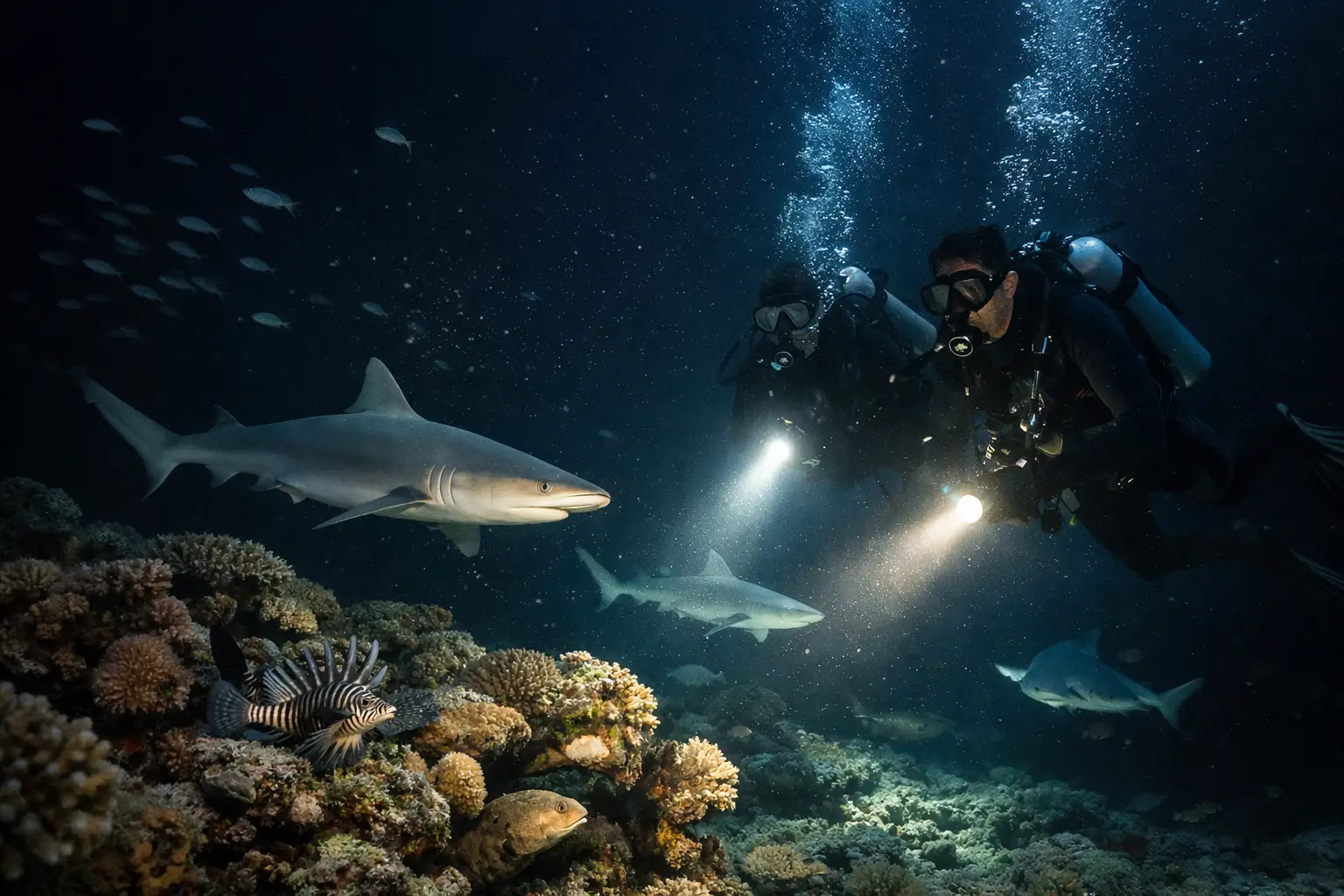
Crabs, lobsters, shrimps, sea stars, nudibranchs, and other invertebrates become more active. Moray eels may hunt beyond their usual daytime shelter. Lionfish and scorpionfish can be easier to spot as they wait patiently near the reef. Look closely at the sand and rubble patches, too. These areas can reveal small octopuses, flatworms, and juvenile fish that blend into the bottom by day.
Sleeping reef fish provide another unexpected sight. Many wedge themselves into protected spaces, change color, or become noticeably less responsive. This is fascinating behavior to observe, but it also calls for restraint. Lights should never be held directly on an animal for long, and divers should not touch, prod, or crowd marine life for a photograph.
Larger animals deserve the same measured respect. A shark silhouette at the edge of a torch beam can be an unforgettable moment, yet night is never a reason to abandon established protocols. Experienced guides assess the site, conditions, visibility, and guest experience before deciding whether a particular night dive is appropriate. Encounters should always be on the animal’s terms.
The Magic of Bioluminescence
One of the most memorable moments on a night dive can happen when every light is switched off. In suitable conditions, divers may briefly cover their lights, maintain close buddy contact, and wave a hand through the water to see tiny flashes of bioluminescence.
This is not a stunt to attempt casually. The group must be stable, the site must be appropriate, and the guide’s briefing must be followed precisely. Done well, those few dark, quiet minutes offer a powerful reminder that the ocean produces its own light.
Night Diving Safety Starts Before the Boat Leaves
Night diving is well within the reach of recreational divers, but it demands more discipline than a casual twilight swim. The goal is not to make the experience feel intimidating. It is to remove avoidable stress so divers can enjoy what they came to see.
A strong pre-dive briefing should cover the site layout, planned route, depth and time limits, entry and exit procedures, current expectations, boat-light signals, and what to do if a buddy is temporarily out of view. Hand signals still work at close range, but light signals become a key part of communication. Divers should never shine a light directly into another diver’s face, and should keep their beam controlled around wildlife.
Equipment preparation matters more in the dark. Every diver should have a primary light, a reliable backup light, and an activated tank marker light where required by local procedure. Check batteries, switches, and attachments before departure, not on the descent line. A secure, streamlined setup prevents an otherwise minor issue from becoming distracting underwater.
Buoyancy deserves special attention. Reduced visual reference can make depth and distance feel different, especially on a darker sandy bottom or in open water. Maintain a conservative profile, use your instruments deliberately, and stay aware of the reef below and around you. Good trim is also a conservation practice: it helps prevent accidental contact with corals and fragile marine life when visibility is limited.
Who Should Try a Night Dive?
Night diving is ideal for certified divers who are comfortable with basic skills and want to see a familiar environment from a new perspective. You do not need hundreds of logged dives to enjoy it. What matters more is your comfort managing your own equipment, maintaining neutral buoyancy, and following a plan without rushing.
If you recently completed your certification, a daylight orientation dive or a refresher may be the smart choice before going out after sunset. Divers returning after a long break should be honest about their comfort level. There is no prize for forcing a night dive when a skills review will make the next one more enjoyable.
For aspiring divers, night diving can become an excellent goal rather than a first-day expectation. SSI training builds the foundational skills that make advanced experiences feel exciting rather than overwhelming. With the right progression, divers can move from learning the fundamentals to confidently exploring reefs in low-light conditions under professional supervision.
How to Get More From the Experience
Arrive rested, hydrated, and early enough to organize your gear without pressure. Night dives reward a calm mindset. Eat before the trip, but avoid a heavy meal immediately before entering the water, and bring a light layer for the ride back when wet skin meets evening air.
Underwater, resist the instinct to search rapidly with your light. Sweep slowly, look under ledges without placing your hands on the reef, and let your eyes adjust between subjects. If you are carrying a camera, keep the setup simple. Video lights and strobes can attract particles in the water column, so thoughtful positioning and patience generally produce better images than more powerful lighting.
Buddy awareness is non-negotiable. Stay within easy visual range, check in often, and agree before the dive on how you will respond to a separation. In most cases, the correct response is simple: look briefly, then surface according to the plan. Do not turn a small navigation issue into an extended search.
A Conservation-Minded Way to See the Reef
Night reveals how much life depends on the reef remaining undisturbed. Corals are not scenery, and nocturnal animals are not props. The most rewarding divers are the ones who can approach closely without making contact, use light thoughtfully, and leave the site looking exactly as it did before they arrived.
That approach aligns naturally with Coral Coast Divers’ conservation-led view of marine adventure. Exceptional encounters and careful stewardship belong together. Whether the evening brings tiny crustaceans, sleeping fish, or the distant shape of a passing shark, the privilege is seeing natural behavior without changing it.
If you are planning night diving in Pacific Harbour, choose a team that treats the briefing, the site, and the animals with equal seriousness. Bring curiosity, solid basic skills, and patience. Once the surface goes dark and the reef begins its night shift, the ocean will provide the rest.