
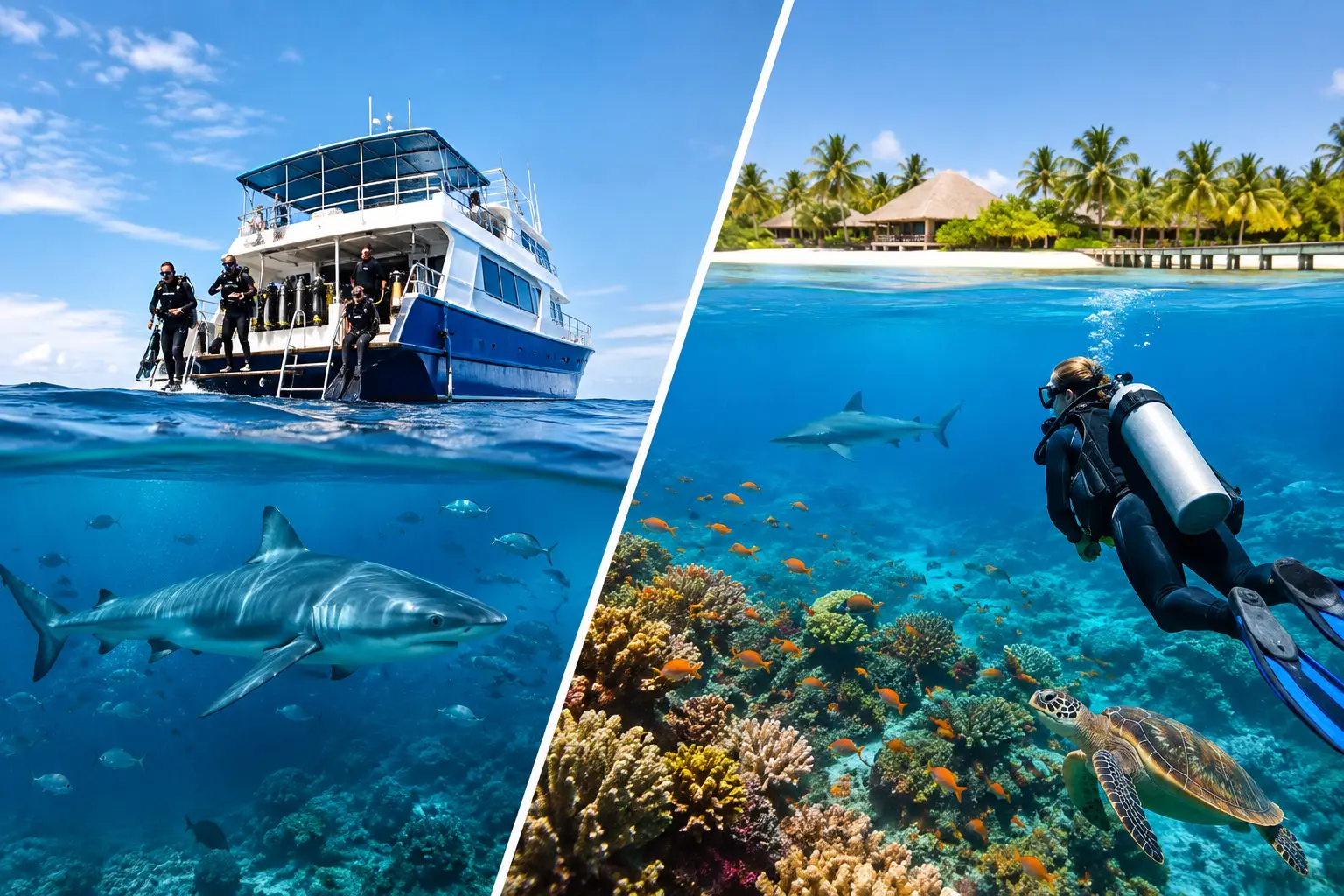
A predawn briefing, a giant stride into open blue water, and the possibility of a tiger shark appearing beyond the reef are powerful reasons to plan a dive trip. But before choosing a destination, divers face a more practical question: liveaboard versus resort diving. Both can deliver exceptional underwater experiences, yet they create entirely different vacations above the surface.
The right choice depends less on which format is “better” and more on what you want your days, dives, and downtime to look like. Are you trying to log as many dives as possible? Traveling with a non-diving partner? Focused on one signature shark experience? Hoping to combine certification, reef exploration, local culture, and time to reset between adventures? Those answers should shape your itinerary.
Liveaboard Versus Resort Diving at a Glance
A liveaboard is a dive-focused vessel that serves as your accommodation, transportation, and daily dive platform. You sleep aboard the boat and travel through a dive region, often waking near the next site. The format is designed around access and immersion: multiple dives per day, early starts, detailed briefings, and a close-knit group of divers sharing a highly concentrated experience.
Resort diving uses a land-based hotel or resort as your home base, with daily boat departures to nearby sites. You may dive once, twice, or several times in a day, then return to shore for meals, a pool, a spa treatment, a walk on the beach, or an evening exploring the destination. It offers more room to balance diving with travel.
Neither format is automatically more advanced, more luxurious, or more conservation-minded. The quality comes down to the operator, the itinerary, group size, crew standards, and how thoughtfully the experience is run.
Choose a Liveaboard When Dive Time Is the Priority
The strongest case for a liveaboard is simple: it can put divers closer to remote sites and maximize time underwater. Instead of returning to shore after each day, the vessel moves while guests rest, eat, or review footage. That can mean fewer long daytime crossings and more opportunities to dive at the moments a site is at its best.
This is particularly appealing to experienced divers, underwater photographers, and guests who have traveled a long way for a specific ecosystem. A multi-day itinerary can also create continuity. You may revisit an area under different conditions, build familiarity with the dive team, and settle into a rhythm of briefing, diving, logging, eating, and resting.
There are trade-offs. Liveaboard schedules are usually fixed, and dive days can be full. Four dives a day may sound ideal before departure, but underwater exertion, sun exposure, current, and repetitive gear handling add up quickly. Sea conditions also matter. If you are prone to motion sickness, sleeping and dining aboard a moving vessel may affect the experience.
A liveaboard can be less flexible for travelers who want to skip a day of diving, visit local communities, or spend time with family members who do not dive. It is best approached as a dedicated dive expedition rather than a general beach vacation with scuba added on.
Who Gets the Most From a Liveaboard?
Divers who are comfortable with busy schedules, boat routines, and spending most of their trip offshore are often the best fit. It is also a strong option for people pursuing remote reefs, broad regional itineraries, or a high volume of dives in a limited travel window.
Before booking, ask about the vessel’s diver-to-guide ratio, emergency equipment, medical oxygen, evacuation planning, experience requirements, night-dive procedures, and how weather changes are handled. A full schedule is valuable only when it is supported by disciplined safety practices.
Choose Resort Diving for Flexibility and Depth of Experience
Resort diving gives you a reliable base between dives. That may sound like a small difference, but it changes the entire feel of a trip. You can start the day with a two-tank boat dive, return for lunch, then decide whether an afternoon reef dive, an SSI course session, snorkeling excursion, or quiet afternoon is the right move.
For travelers coming to Fiji, a resort-based format can make room for more than a dive log. It allows time for the landscape, the people, the food, and the pace of the islands. It is also more practical for mixed-interest groups. One person can join a guided dive while another enjoys a beach day, a village visit, or an ocean activity from shore.
Land-based diving is especially useful when a destination has standout sites within practical boat range. Pacific Harbour is a prime example. Divers can combine colorful reef systems and training opportunities with the intensity of a professionally managed shark dive at The Colosseum, then return to land with time to decompress and share the day’s stories.
That flexibility matters for newer divers, too. A resort itinerary can reduce the pressure of an all-day boat schedule and create a more comfortable progression from training dives to deeper exploration. For certified divers, it offers the freedom to tailor the week around energy levels, weather, and personal goals.
The Limits of a Resort-Based Schedule
Resort diving does not always reach the same remote areas as a liveaboard. Daily boat travel can be longer, and some departure times or dive sites may be dictated by tides, weather, or local marine conditions. You may log fewer dives overall than on an aggressive liveaboard itinerary.
That is not necessarily a disadvantage. More dives do not always equal a better trip. A rested diver who takes time to observe shark behavior, refine buoyancy, review camera settings, and appreciate a reef may gain more from two excellent dives than four rushed ones.
Shark Diving Changes the Decision
If shark encounters are a central reason for traveling, assess the actual dive experience rather than assuming one accommodation style will be superior. The key questions are whether the site is reliably accessible, how the operation manages group positioning, what species may be encountered, and whether the team follows clear procedures for diver conduct and marine stewardship.
A premium shark dive should never feel improvised. Thorough briefings, controlled entries and exits, experienced guides, appropriate spacing, and calm observation are essential. The most memorable encounters are built on respect for the animals and an understanding that conditions can change. Sharks are wildlife, not a guaranteed performance.
Resort diving can be the better choice when a renowned shark site is close to shore and you want to make it part of a wider itinerary. At Coral Coast Divers, the shark dive at The Colosseum is paired with professional guidance and a private marine protected area approach, allowing guests to pursue a bucket-list encounter without giving up the variety of a Fiji vacation.
A liveaboard may be better if your goal is to encounter sharks across multiple remote locations or combine pelagic action with a broad range of reefs, walls, and atolls. The deciding factor is the itinerary’s quality, not the label on the trip.
Consider Your Surface Interval as Carefully as Your Dive Plan
The best itinerary protects your energy. Divers sometimes compare packages by counting dives alone, but surface intervals, meals, hydration, sleep, and comfort directly influence enjoyment and safety. A well-designed trip leaves room to recover, especially after deep dives, current, repetitive descents, or long days in the sun.
Think honestly about the trip you want to remember. A liveaboard may give you the satisfying rhythm of a true expedition, where each day is organized around the sea. A resort may give you the luxury of choosing your pace, returning to a comfortable room, and waking up ready for a different kind of adventure.
For couples and groups, this question becomes even more important. Resort diving is often easier when interests and confidence levels differ. A liveaboard works best when nearly everyone is there for the same reason: to spend as much time diving as possible.
Questions to Ask Before You Book
Ask how many divers are assigned to each guide, what certification level and recent experience are recommended, and whether the operation can accommodate private guiding or additional training. Find out what is included in the stated price, from equipment and nitrox to transfers, park fees, meals, and marine conservation contributions.
Also ask how the operator handles changing conditions. Responsible diving does not mean forcing a planned site when wind, current, visibility, or diver readiness suggests another choice. The strongest dive teams make conservative calls clearly and confidently.
Finally, look for evidence that the operation protects what it shows you. Reef-friendly practices, careful wildlife protocols, local marine education, and active conservation work are not side benefits. They help preserve the underwater environments that make a journey worth taking.
Your choice between a liveaboard and a resort does not need to be permanent. Choose the format that serves this particular trip, then leave enough space in the plan for the unexpected moment that makes diving unforgettable: a silent shark passing through the blue, a reef alive with movement, or the quiet confidence of realizing you are exactly where you wanted to be.