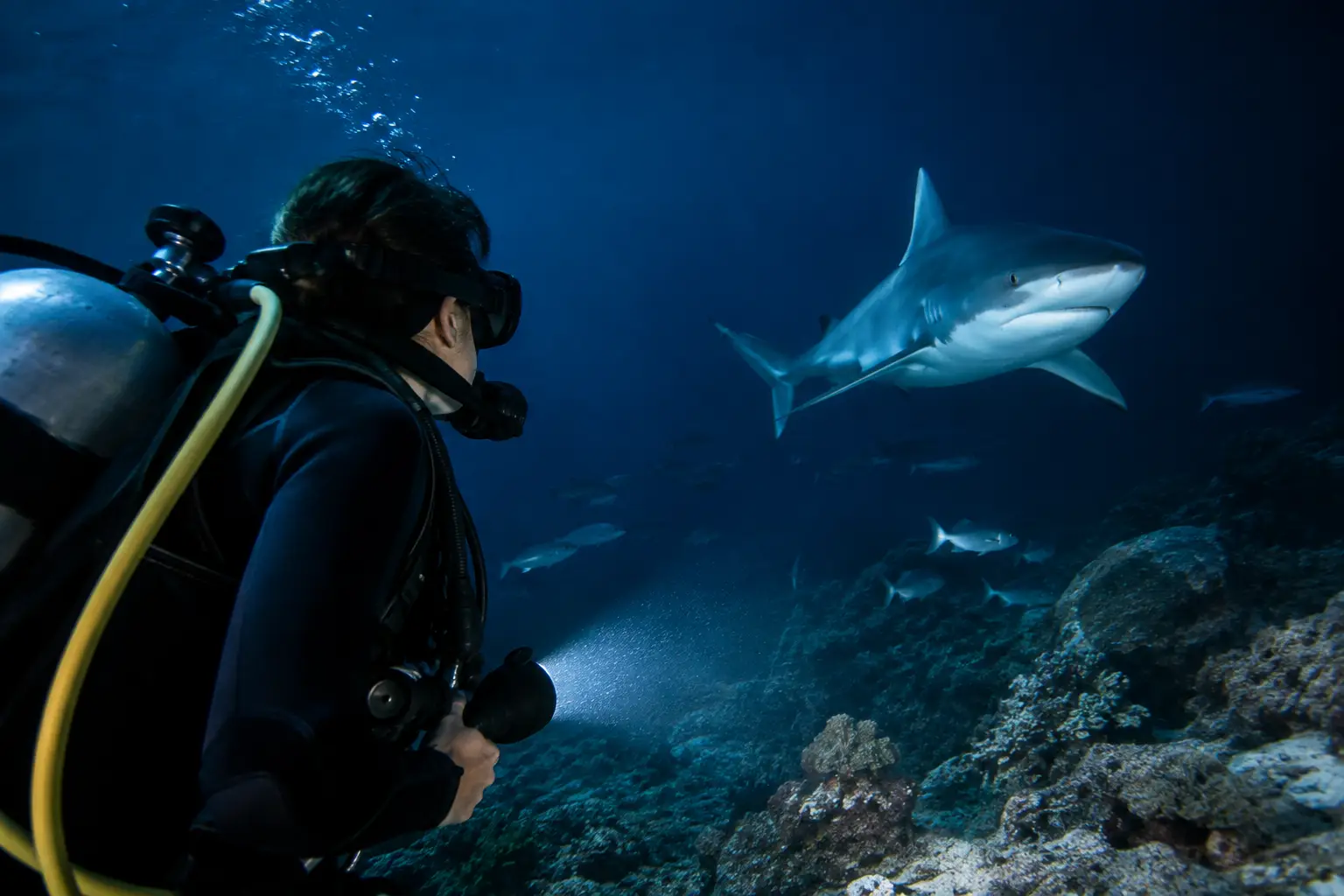
A familiar reef can feel entirely new after sunset. Colors narrow under the beam of a dive light, daytime fish settle into the coral, and creatures rarely seen in daylight begin moving across the sand. Knowing how to prepare for night dives turns that sense of mystery into a focused, genuinely rewarding experience – not a leap into the unknown.
Night diving is not inherently extreme, but it asks more of your planning, awareness, and communication. A good night dive begins long before the sun drops below the horizon. It starts with an honest assessment of conditions, skills, equipment, and the people in your buddy team.
Build confidence before darkness arrives
Your first few night dives should be conducted at a familiar, uncomplicated site with a qualified guide or instructor. Avoid making a first night dive a deep dive, a strong-current dive, a complicated entry, or a major photography mission. Each added variable takes attention away from the fundamental task: staying calm, oriented, and connected to your buddy.
If you have not dived recently, refresh the essentials in daylight first. Practice a controlled descent, hover without touching the reef, clear your mask, recover your regulator, and deploy your surface marker buoy if it is part of the plan. These are straightforward skills in clear daylight. At night, they must feel automatic.
Buoyancy deserves particular attention. Poor buoyancy is more noticeable after dark because your visual references are reduced. A diver who relies on seeing the bottom clearly to maintain depth may drift upward, sink into the reef, or stir sediment when their light moves away. Start properly weighted, make slow adjustments, and use your computer, pressure gauge, and instruments deliberately rather than repeatedly shining your light around in search of a reference.
Plan the dive while you can still see
A detailed pre-dive briefing is the backbone of night-dive safety. Discuss the route, maximum depth, planned bottom time, turn pressure, exit point, and what the group will do if current or visibility differs from expectations. Agree on whether the dive is a simple out-and-back route, a reef circuit, or a moored exploration around a fixed point.
Night navigation is easiest when the plan is conservative. Natural navigation still works: follow a reef edge, maintain a consistent depth, note the slope direction, and look for distinctive coral formations or sand channels. A compass is valuable, but it should support the plan rather than replace situational awareness. Check it periodically, especially after turning or changing depth.
Confirm lost-buddy procedures before entering the water. The standard response is often to search briefly while staying in place, then surface safely if contact is not restored. Your operator’s procedures and local conditions may call for a specific variation, so follow the briefing. What matters is that no one improvises in the dark.
Set clear limits for the dive. A shorter, calm night dive is far better than extending bottom time because the marine life is interesting. Fatigue, cooling, low air, and task loading are easier to overlook when everyone is absorbed in a narrow cone of light.
Choose lights that support the plan
Your primary light is not an accessory. It is essential life-support-adjacent equipment for a night dive. Select a dependable light with a beam that is bright enough to illuminate your immediate path without creating excessive backscatter in suspended particles. Test it before leaving the dive center, inspect the O-ring and seal, and make sure the battery charge is sufficient for longer than the planned dive.
Every diver needs an independently powered backup light. Store it where you can reach it with either hand, and know how to activate it without looking. A failed primary light is manageable when a backup is ready; it becomes stressful when the backup is loose in a bag or has never been tested.
Use a tank marker light so your buddy and guide can identify you quickly. Make sure it is secure and visible without dangling where it can snag coral or equipment. A compact slate can also be useful when detailed communication is needed, although most issues should be handled with agreed hand and light signals.
Before descent, check these essentials together:
- Primary light, backup light, and marker light all function correctly.
- Mask, fins, exposure protection, computer, and gauges are secured and easy to access.
- Air supply, weights, releases, and buddy equipment receive a deliberate pre-dive check.
- Surface signaling equipment is appropriate for the site and the operator’s procedures.
A camera setup deserves extra restraint. Underwater video and still photography at night can be spectacular, but strobes, focus lights, and controls create real task loading. If you are new to night diving, leave the camera behind for the first dive or two. Learn the environment first, then add creative equipment once your buoyancy and buddy awareness remain effortless.
Communicate with your buddy using light and touch
A night-dive buddy team should stay closer than it might during an open-water daytime dive. You do not need to hover shoulder to shoulder, but you should be close enough to see each other’s light and gain attention quickly. Keep your beam angled down and ahead rather than sweeping it directly across your buddy’s face.
Light signals work best when they are simple. A broad circle or deliberate beam movement can mean “look here,” while a slow side-to-side sweep often signals attention. Once your buddy is looking, use standard hand signals in the light. Avoid shining a bright beam into someone’s mask unless there is an urgent reason to do so.
Touch communication can be useful in close quarters, during a temporary light issue, or when a diver is distracted. Agree on a few basic cues during the briefing, such as a gentle tap to get attention. Do not invent complicated tap codes underwater. If a message cannot be communicated clearly, pause, stabilize, and use a slate or end the dive.
Good communication also means resisting the urge to separate for a better view. Many nocturnal animals appear when divers remain still. Slow down, stay with your team, and let the reef reveal itself.
Respect the reef after dark
Night diving offers a close look at a different shift on the reef. Parrotfish may sleep in crevices, crustaceans emerge from cover, and hunting predators become more active. This does not make the reef a stage for chasing, touching, or repositioning animals for a photograph.
Keep your hands off coral, shells, and marine life. Do not block an animal’s retreat or shine a powerful light into its eyes for an extended period. On a shark dive or reef excursion, calm positioning matters even more: stay aware of the guide’s instructions, maintain your assigned place, and allow animals space to move naturally. Respectful encounters are safer for divers and less disruptive to the marine environment.
Excellent buoyancy is conservation in practice. Fin carefully over the reef, avoid kneeling on the bottom, and secure every hose, gauge, and camera accessory. At night, a loose item is easier to miss and more likely to damage fragile coral before you notice it.
Account for conditions, not just certification
Certification is the beginning of preparation, not a guarantee that every night dive is appropriate. Current, surface chop, rain, limited shore access, boat traffic, moon phase, and visibility can change the character of a site dramatically. Warm tropical water can make a night dive physically comfortable, but it does not remove the need for thoughtful planning.
Listen to local professionals who know how a specific site behaves after dark. In Pacific Harbour, Fiji, experienced guides can help match the route and conditions to your comfort level while showing you the reef with minimal impact. Coral Coast Divers approaches every guided experience with the same priorities: clear procedures, attentive supervision, and respect for the marine ecosystems that make a night dive worth taking.
If you feel anxious before the descent, say so. A professional team would rather adapt the plan, offer additional guidance, or recommend a daytime orientation dive than pressure anyone into the water. Confidence grows from preparation and repetition, not from pretending discomfort is not there.
Finish the dive as carefully as you started
The ascent and exit deserve the same attention as the exploration phase. Check air and no-decompression limits early enough that you can return without rushing. Make a controlled ascent with your buddy, complete the planned safety stop, and keep visual contact through the surface procedure.
Once out of the water, do a quick debrief while details are fresh. Did your lights perform as expected? Was your weighting correct? Did the navigation plan make sense? A few practical notes can improve the next night dive immediately.
The reward for thoughtful preparation is not simply seeing the reef in darkness. It is experiencing a familiar underwater world on its own terms – quieter, stranger, and alive with behavior most daytime divers never witness.