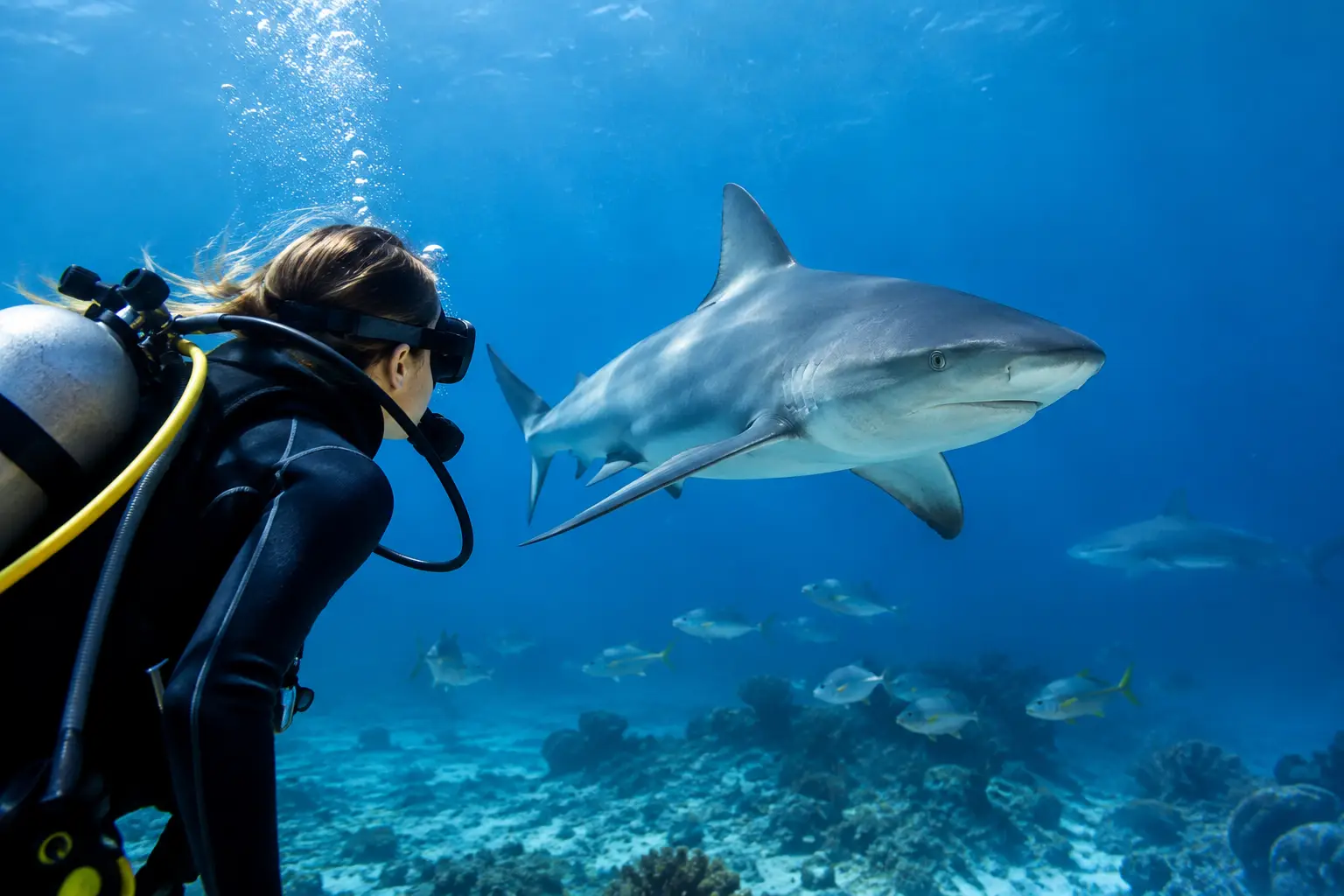
A bull shark passes through clear water with the calm confidence of an animal perfectly suited to its environment. For divers, that moment can be transformative. But are shark dives ethical? The honest answer is that they can be – when the encounter puts the shark, the reef, and the local community ahead of spectacle.
Shark diving is not automatically conservation, and it is not automatically exploitation. The ethics depend on how an operation is run: where dives take place, how wildlife is approached, whether feeding is controlled, what safety standards protect both people and animals, and whether tourism creates a genuine reason to preserve sharks alive.
Why Shark Diving Raises Ethical Questions
Sharks are not props. They are long-lived predators with complex roles in marine ecosystems, and many species reproduce slowly. A poorly managed interaction can disrupt natural behavior, create avoidable stress, or teach visitors that close wildlife encounters are entertainment without responsibility.
The largest ethical question around some shark dives is provisioning, sometimes called feeding or chumming. Food can bring sharks into a predictable area, making encounters possible for divers and creating economic value for animals that have too often been treated as disposable. Yet it also deserves serious scrutiny. The concern is whether repeated food rewards alter behavior, change movement patterns, concentrate animals unnaturally, or increase risk through careless practices.
There is no single answer that applies to every species, site, or operation. A tightly controlled dive in a managed location is fundamentally different from an unregulated boat dropping bait near swimmers, reefs, or fishing activity. Context matters.
What Makes a Shark Dive Ethical?
An ethical shark experience begins with an operator that treats the encounter as a privilege, not a performance. That means clear procedures, trained staff, conservative decision-making, and respect for the natural limits of the site.
At a responsible site, divers are briefed before entering the water. They understand body position, buoyancy, eye contact, camera etiquette, and the importance of staying in their assigned area. Guides monitor the group continuously and adjust the plan if conditions, diver behavior, or shark behavior call for it. No one should be encouraged to chase, touch, corner, or provoke an animal for a closer photograph.
Good operations also keep the experience structured. The number of divers, their placement, the timing of the dive, and any provisioning protocol should be designed around predictable, low-impact interactions. This is particularly relevant when large, food-motivated sharks are present. A well-run shark dive is not casual. It is calm, disciplined, and led by professionals who know the animals and the environment.
The site itself matters just as much. Protected or carefully managed dive areas can reduce conflict with fishing pressure and create a refuge where sharks and reef life are valued. At The Colosseum in Beqa Lagoon, Coral Coast Divers operates shark dives within a private marine protected area, combining closely managed encounters with a broader commitment to reef stewardship, education, and marine research.
Tourism Can Give Sharks Economic Value Alive
For many coastal communities, shark tourism has changed the conversation around protection. A living shark that supports recurring dive tourism can generate far more long-term value than a shark removed once from the ocean. That does not make every commercial interaction ethical, but it does explain why responsible tourism can be a powerful conservation tool.
Revenue from well-managed diving can support local jobs for boat crews, guides, instructors, hospitality teams, and marine staff. It can also help fund site monitoring, coral restoration, conservation education, and advocacy for stronger protections. When visitors choose operators that invest locally and operate transparently, their travel spending becomes part of a larger incentive to keep marine ecosystems healthy.
There is another benefit that is harder to measure but equally meaningful. People protect what they understand. Seeing a shark move with purpose rather than aggression often replaces fear with respect. Divers return home with a more realistic view of these animals and a stronger willingness to support protections that may otherwise feel distant.
The Trade-Offs Responsible Divers Should Understand
Ethical shark diving does not mean pretending there are no trade-offs. Provisioning remains debated among scientists, conservationists, and dive professionals. Research outcomes can vary by location, shark species, food source, and the consistency of management. Responsible operators should not make sweeping claims that every feeding practice has no effect.
Instead, they should be able to explain their procedures and why they use them. Are sharks fed in a fixed underwater area rather than from the surface? Is the activity separated from swimming beaches and busy fishing areas? Are handlers trained? Is there a strict diver-to-guide ratio? Is the operation observing behavior over time and willing to alter practices when evidence calls for it?
Ethics also include carbon use, waste, anchoring practices, and the health of the reef surrounding the encounter. A shark-focused business that damages coral, leaves waste behind, or ignores local stakeholders cannot credibly call itself conservation-minded. Shark protection works best when it is part of a wider commitment to the ocean.
How to Choose a Responsible Shark Dive Operator
Before booking, look beyond dramatic videos. A professional operator should be comfortable answering direct questions about safety, conservation, and wildlife management. Vague promises of an “adrenaline rush” are not enough.
Ask how the dive is supervised and what experience or certification is required. Find out whether there is a detailed briefing, whether divers stay within designated positions, and whether guides have the authority to stop a dive. For a premium shark encounter, excellent operational control is part of the experience, not a limitation on it.
Ask how the operator protects the site outside the dive itself. Do they participate in reef restoration, shark behavior research, marine education, or local conservation initiatives? Do they use moorings rather than dropping anchors on coral? Are groups kept manageable? The strongest answers are specific and practical.
Pay attention to the language used in marketing, too. Responsible operators speak about sharks with respect. They do not promise that guests will touch animals, hand-feed them, or force a dramatic encounter. Wildlife is never fully scripted, and that uncertainty is part of what makes a real ocean experience valuable.
Your Conduct Matters Underwater
Even the best operator cannot make a shark dive ethical without responsible guests. Divers have a role in protecting the animals they came to see.
Maintain neutral buoyancy and avoid finning into coral or sand. Stay where your guide places you, keep your hands to yourself, and do not use a camera as an excuse to drift too close. If a shark changes direction, approaches, or displays behavior you do not understand, remain calm and follow the guide’s instructions.
For newer divers, honesty about your comfort level is essential. Shark diving can be exhilarating, but it requires control in the water. Taking time to refresh buoyancy skills, improve air consumption, or complete appropriate training can make the experience safer and more rewarding. A responsible adventure is not about proving bravery. It is about being prepared enough to observe without becoming a disturbance.
The Ethical Standard Is Ongoing
The best shark dive operations do not consider ethics a badge earned once. They keep evaluating their impact, listening to science, training staff, maintaining equipment, and adapting procedures. Conditions change. Marine research develops. A method that is acceptable at one site may not suit another.
That is the standard travelers should expect: not perfection or empty conservation claims, but transparency, discipline, and a demonstrated willingness to put the marine environment first. Choose an encounter that leaves you with more than extraordinary footage. Choose one that makes you a better witness for the ocean and gives sharks one more reason to be protected where they belong.