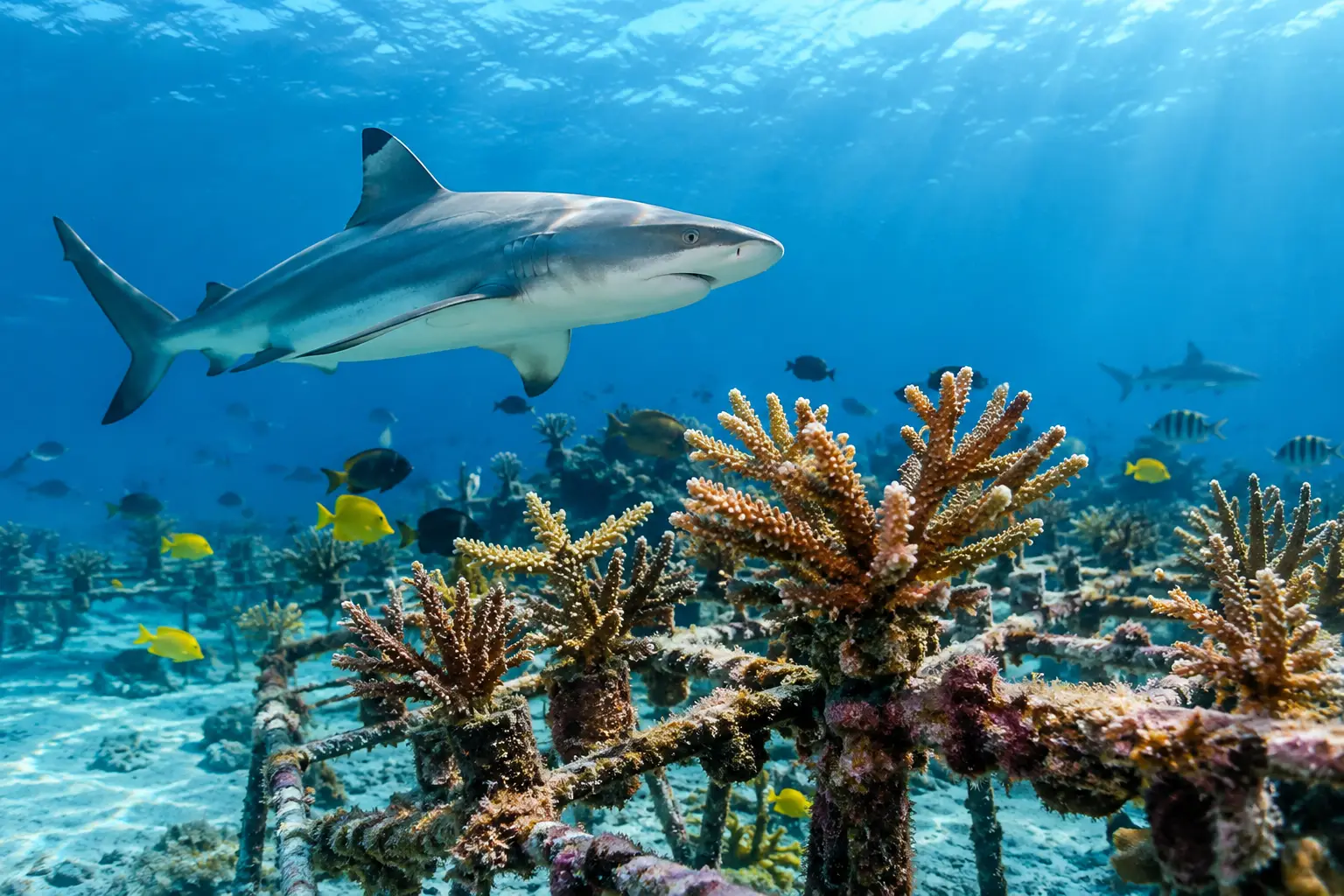
A newly planted coral fragment can look like an instant conservation success on a morning dive. It is secured to the reef, upright in clear water, and surrounded by fish. But meaningful coral planting outcomes are not measured on that day. They emerge months and years later, when the fragment has survived heat, storms, grazing, disease pressure, and the everyday competition of life on a reef.
For divers visiting Fiji, coral planting offers a rare chance to see conservation as practical fieldwork rather than a distant promise. It also deserves an honest view. Planting coral can support reef recovery, create habitat, and build public commitment to ocean protection. It is not a quick fix for warming seas, poor water quality, or destructive fishing practices. The strongest programs pair hands-on restoration with careful monitoring and protection of the wider marine environment.
Coral Planting Outcomes Start With the Right Question
The first question is not simply, “How many corals were planted?” A more useful question is, “What is this planting meant to achieve at this site?” The answer may be restoring damaged coral cover, increasing habitat complexity for reef fish, preserving valuable coral genotypes, or helping a local reef recover after a specific disturbance.
Each goal requires different measures of success. A project focused on coral cover may track how much living tissue occupies the reef over time. A habitat project may measure fish abundance, juvenile fish recruitment, or the return of reef-dependent species. If resilience is the priority, researchers may look closely at whether planted corals survive seasonal heat stress and reproduce.
Survival is still essential, but it is only the beginning. A fragment that remains alive but does not grow, branch, attach securely, or contribute to reproduction has limited long-term value. The best outcomes show that corals are becoming functioning parts of the reef, not just surviving pieces on a frame or restoration plot.
Why Site Selection Can Matter More Than Planting Volume
Corals cannot thrive because they were planted with good intentions. They need the conditions that fit their species: appropriate depth, light, water movement, temperature range, and stable substrate. A fast-growing branching coral may perform well in one sheltered area but be vulnerable at a more exposed site. A coral that tolerates stronger surge may be a poor choice for a calm lagoon.
This is why responsible restoration begins with assessment. Teams examine existing reef communities, storm exposure, sediment movement, algae growth, and signs of disease. They also consider what caused the original damage. If anchors, sediment runoff, or repeated physical impacts remain unaddressed, planting more corals into the same conditions can produce disappointing results.
In Pacific Harbour, reef systems can vary significantly over relatively short distances. Local knowledge matters. Experienced dive professionals and marine teams can recognize how currents, weather patterns, and site use influence the placement and long-term care of restoration areas.
There is a practical trade-off here. Large-scale planting can create impressive numbers and engage more visitors, but scale without site suitability can waste time and living coral material. Smaller, well-monitored plots often generate better information and more dependable results than ambitious planting targets alone.
The species and genetics question
Coral restoration is not only about putting more coral back onto a reef. It is also about avoiding a reef made up of too few species or too little genetic diversity. A healthy reef has varied forms: branching corals that create shelter, massive corals that can persist for decades, encrusting species that stabilize surfaces, and many others that fill different ecological roles.
Using a narrow selection of fast-growing species may produce visible change quickly. Yet a reef dominated by just one or two types can be more vulnerable when conditions shift. Responsible programs consider species diversity, source colonies, and local ecological fit. Where possible, they avoid repeatedly taking fragments from the same few donor colonies.
That work is less dramatic than a before-and-after photograph, but it is central to long-term reef resilience.
How Coral Planting Outcomes Are Measured
A credible program records what happens after the planting day. Monitoring should occur at consistent intervals and use methods that allow results to be compared over time. Divers may document survival, growth, attachment, bleaching, disease signs, predation, and damage from storms or loose gear.
Photographic monitoring is especially valuable. Repeating images from the same positions can show whether coral cover is expanding, whether fragments are fusing with the natural reef, and whether surrounding habitat is changing. Measurements of branch length or colony area can add useful detail, while broader reef surveys reveal whether fish and invertebrate communities are responding.
Good monitoring also makes room for failure. If some fragments die, the lesson may point to a poor attachment method, unsuitable depth, a heat event, or a species mismatch. A program that reports only its wins cannot improve as quickly as one that studies setbacks openly.
The most useful indicators often include:
- survival and growth over multiple seasons, not only the first few weeks
- secure attachment and integration with the natural reef structure
- species and genetic diversity across the restored area
- signs of ecological function, such as fish shelter, recruitment, and natural coral settlement
- the condition of the surrounding reef, including algae, sediment, disease, and human impacts
No single number tells the full story. High survival can be encouraging, but it does not automatically mean a reef is becoming more resilient. Likewise, an area can look sparse after a disturbance while still be recovering naturally through coral larvae settlement. Restoration teams need to understand when planting adds real value and when protecting natural recovery is the wiser course.
What Divers Can Contribute Beyond a Single Planting
For visiting divers, participation has value when it is handled with proper briefing, supervision, and respect for the reef. The work should never compromise buoyancy control or place participants where they may accidentally damage nearby coral. A careful orientation explains how fragments are handled, how they are secured, and why the project uses a particular method.
Divers can make their greatest contribution by treating every reef as a restoration site, whether or not they are planting. Excellent buoyancy, secure equipment, controlled finning, and a no-touch approach prevent avoidable damage. Choosing reef-safe practices on shore matters too: reduce single-use waste, respect local marine rules, and support operators that invest in marine protection and education.
Photography deserves particular care. A close image is never worth kneeling on the reef, grabbing a rock for balance, or stirring sediment over sensitive coral. Skilled underwater photographers can document restoration progress without becoming part of the pressure a reef is trying to overcome.
For certified divers, continuing education can deepen that contribution. Courses and guided experiences that build buoyancy, marine ecology awareness, and conservation knowledge help turn interest into reliable in-water habits. New divers can begin with the same mindset: calm movement, thoughtful observation, and trust in professional guidance.
Restoration Works Best Alongside Protection
Coral planting is most effective when it supports a protected, well-managed reef rather than standing in for reef protection. Marine protected areas, responsible tourism practices, community involvement, fisheries management, and water-quality measures address the pressures that make restoration necessary in the first place.
This is especially relevant in shark-diving regions. Healthy shark populations are connected to healthy marine ecosystems, even if the relationship is not always visible on a single dive. Predators, reef fish, coral habitat, and nutrient cycles are part of an interconnected system. Protecting the places where divers encounter sharks, rays, schooling fish, and colorful coral communities creates a stronger foundation for restoration work.
At Coral Coast Divers, conservation-led diving is built around the idea that remarkable encounters and responsible operations should reinforce each other. A planted coral is more meaningful when it sits within a reef culture shaped by safety, education, site stewardship, and respect for the animals that depend on it.
The next time you see a coral nursery or restoration plot, look past the number of fragments on display. Ask what species are being grown, why the site was chosen, how results are monitored, and what protections surround the reef. Those answers reveal whether a planting effort is giving coral a genuine chance to become part of Fiji’s living underwater future.