
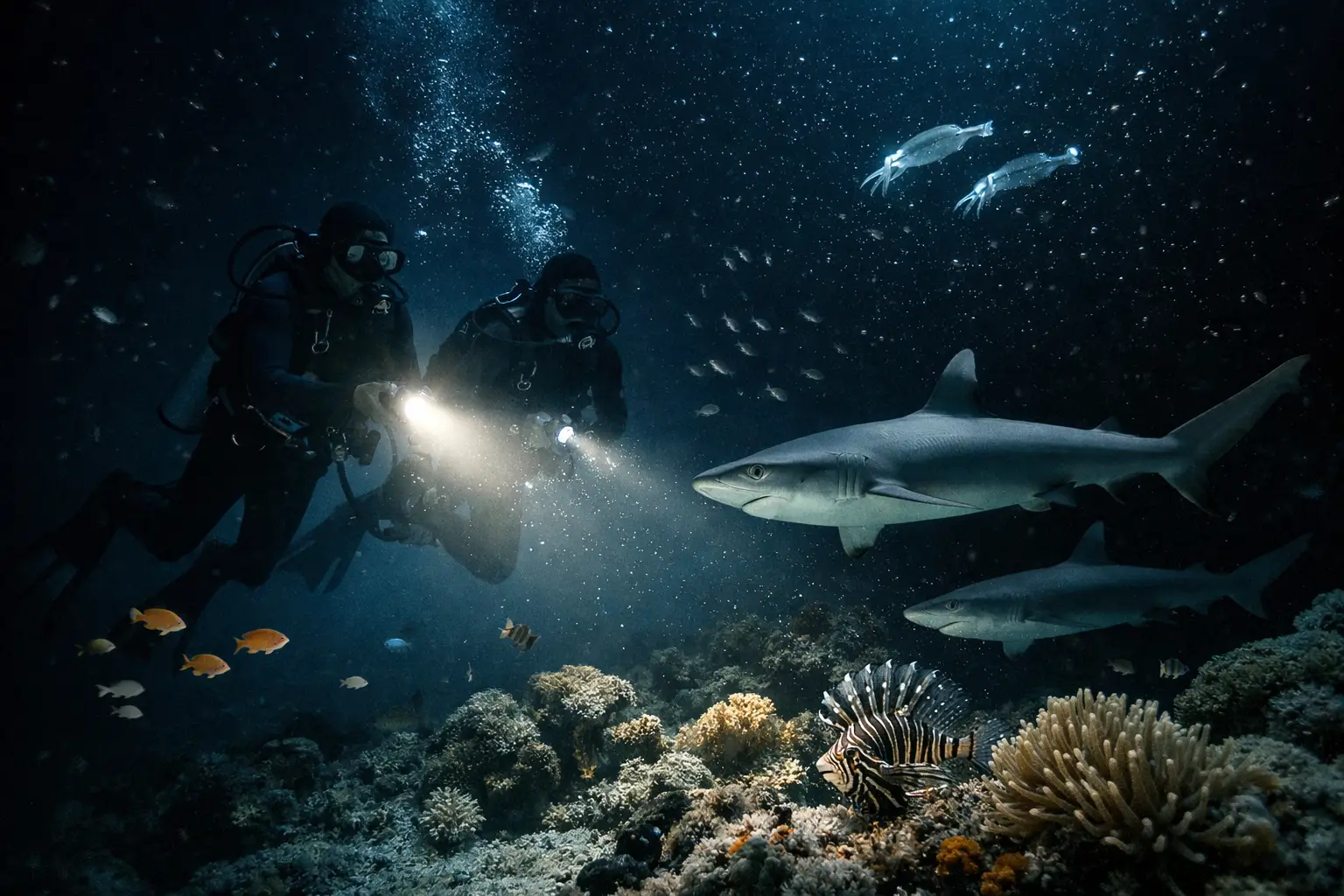
The reef changes the moment the sun goes down. Daytime fish settle into sheltered crevices, coral polyps extend to feed, and creatures rarely seen in daylight begin to move. So, are night dives suitable for beginners? They can be – but only when the diver has the right foundation, the site is forgiving, and the experience is led by professionals who treat preparation as seriously as the adventure.
A first night dive should feel exciting, not like a test of nerve. For a newly certified diver, it can be one of the most memorable ways to build comfort underwater. Darkness narrows your field of view, heightens your awareness of buoyancy and position, and reveals a completely different side of the ocean. It also asks more of your planning, communication, and discipline than a standard daytime reef dive.
Are Night Dives Suitable for Beginner Divers?
Night diving is generally suitable for beginners who are already certified, comfortable with their basic scuba skills, and able to manage themselves calmly in the water. It is usually not the right setting for a first-ever ocean dive or for someone still struggling with mask clearing, buoyancy, equalization, or following a dive plan.
Certification matters, but confidence matters too. A diver with only a few dives can have an excellent first night experience if those dives were recent, conditions are calm, and they have demonstrated solid awareness underwater. On the other hand, a diver with more logged dives who feels anxious, rusty, or easily disoriented may be better served by a daytime refresher first.
The best beginner night dives happen at shallow, familiar, protected sites with easy entries and exits. Visibility does not need to be perfect, but the route should be straightforward, current should be mild, and the group should be small enough for close supervision. A guided night dive is not the place to push depth, challenge strong current, or turn an unfamiliar reef into a navigation exercise.
What Changes After Dark
The water itself does not become inherently dangerous at night. What changes is the information available to you. Your dive light creates a focused circle of visibility, while everything beyond it fades into darkness. That can feel peaceful and immersive, but it means divers must be more deliberate.
Communication becomes more intentional. Your buddy and guide need to stay within the range of your light, and hand signals must be clearly illuminated. A quick light signal can get attention, but shining a beam directly into another diver’s eyes is distracting and discourteous. Before entering the water, the team should agree on light signals, turnaround pressure, maximum depth, and what to do if someone becomes separated.
Navigation also feels different. During the day, a beginner might use the broader shape of the reef, sunlight, and distant visual references to maintain direction. At night, the guide’s route, compass use, depth awareness, and regular checks of position take on greater importance. This is why a well-run briefing is essential, not optional.
There is also a psychological adjustment. Some new divers discover that darkness sharpens their focus in a positive way. Others initially feel exposed when they cannot see the full reef around them. Neither response is unusual. A professional guide should invite questions, set a relaxed pace, and make it clear that choosing to skip or end a dive is always acceptable.
Your Light Is Safety Equipment
Every night diver needs a reliable primary light and a backup. The primary light helps you see marine life, monitor your equipment, read gauges, communicate, and remain visible to your buddy. The backup is there because equipment can fail, even when it has been checked carefully.
A light should be tested before departure, secured so it cannot be dropped, and used with respect for the reef. Avoid holding a powerful beam on one animal for long periods. Never poke into coral, chase creatures into hiding, or use the light as an excuse to get too close. At night, many animals are feeding, resting, or hunting. Observing quietly is part of responsible diving.
Skills to Have Before Your First Night Dive
You do not need advanced certification to enjoy an entry-level night dive, but you should be able to perform core skills without stress. That includes maintaining neutral buoyancy, clearing a partially flooded mask, recovering your regulator, checking your air supply regularly, and ascending slowly while staying close to your buddy.
Good buoyancy is especially valuable after dark. When the visual world shrinks to a beam of light, it is easier to lose track of distance from the bottom or reef. A diver who can hover calmly protects both themselves and the marine environment. Kicking up sand or accidentally touching coral is not just a cosmetic issue – it can damage fragile living structures and disturb nocturnal animals.
A recent skills review can make a major difference. If you have not dived in several months, arrange a refresher or an easy daytime dive before committing to a night excursion. The goal is not to prove that you can handle darkness. The goal is to arrive relaxed enough to enjoy what it reveals.
How Professional Guides Make the Difference
For beginners, the quality of the operation and the guide’s judgment are more important than the novelty of the dive. A strong team assesses weather, sea state, current, visibility, tides, access, and each guest’s experience before choosing whether to proceed. If conditions are not right, postponing the dive is the correct call.
At Coral Coast Divers, night-dive planning is grounded in the same disciplined approach used across guided reef and shark experiences: clear briefings, appropriate site selection, attentive supervision, and respect for Fiji’s marine ecosystems. For a beginner, that structure creates the freedom to be present rather than overwhelmed.
Expect a thorough briefing before you gear up. It should cover the planned route, depth and time limits, how the group will stay together, light etiquette, emergency procedures, marine-life interaction rules, and entry and exit details. Your guide should also ask about your certification, recent dives, comfort level, and any concern you may be hesitant to raise in a group.
Smaller groups are especially valuable after dark. They allow the guide to notice if someone is falling behind, breathing faster than usual, or becoming fixated on their equipment. A calm, observant guide can address a small issue before it grows into discomfort.
What You May See on a Fiji Night Dive
A tropical reef at night rewards patience. Instead of scanning a wide blue seascape, you move slowly and notice details: cleaner shrimp working from a crevice, crabs crossing open sand, octopus changing texture and color, sleeping parrotfish tucked into reef pockets, and coral polyps feeding in the current.
The experience is often quieter than a daytime dive. You may hear the soft crackle of reef life and see the silhouette of your buddy’s light moving ahead. For photographers, night diving offers dramatic possibilities, although beginners should resist the urge to manage a complicated camera setup on their first outing. Prioritize buoyancy, communication, and awareness. The images can wait.
The same rule applies to every encounter with wildlife: look, do not touch. Night-active animals can be more vulnerable to disturbance, and coral needs protection around the clock. Responsible diving means leaving the reef as it was found, while taking away a deeper understanding of how alive it remains after dark.
When a Beginner Should Wait
There are times when waiting is the smart, confident choice. Postpone a night dive if you are feeling ill, exhausted from travel, anxious about your equipment, unfamiliar with basic skills, or uncertain about equalizing. Skip it if conditions involve significant current, surge, difficult shore access, or low visibility beyond what your training and comfort support.
A night dive is also a poor first step after a long break from scuba. Schedule a daytime orientation dive, practice buoyancy and communication, then decide how you feel. There is no prize for doing everything on a single trip. Diving is a lifelong skill, and each well-chosen experience builds the judgment that makes future adventures better.
Before your first night descent, take a slow breath, check that your buddy is close, and let your light settle on the reef. The ocean has not disappeared in the dark – it has simply begun a different shift.