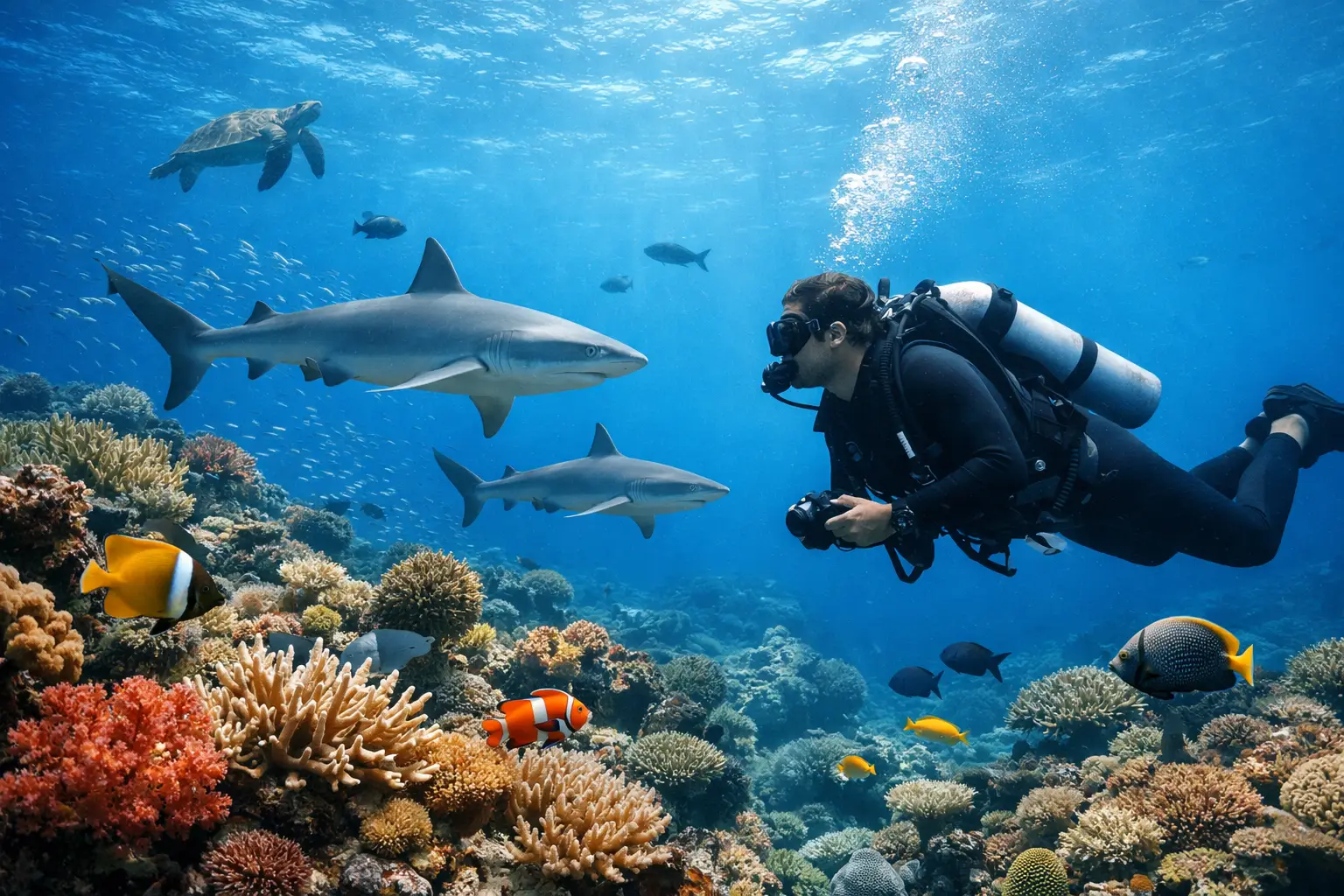
A coral reef can look like a perfectly clear underwater highway from the surface. At depth, it is a living maze of bommies, channels, sandy patches, ledges, and changing light. Knowing how to navigate coral reefs is not about rushing ahead with a compass. It is about reading the site, staying connected to your buddy and guide, and moving through one of the ocean’s most fragile environments without leaving a trace.
For divers visiting Fiji, strong navigation skills turn a beautiful reef dive into a calmer, more confident experience. They also give you more attention for the moments that matter: a turtle moving along the reef edge, a school of jacks passing overhead, or the subtle movement of a shark beyond the coral slope.
Start Your Reef Navigation Before You Enter the Water
The most effective navigation happens before you descend. Listen closely to the dive briefing and build a simple mental picture of the site. Your guide should explain the entry point, intended route, maximum depth, current direction, turnaround point, ascent plan, and any areas that must be avoided.
Ask what the reef is likely to look like at your planned depth. Is there a wall on one side and open blue water on the other? Will you follow a sandy channel between coral heads? Are you starting on a mooring line and returning to it? These details give you reliable reference points long before underwater visibility or excitement begins to test your memory.
A good plan should be simple enough to repeat to your buddy. For example: descend on the mooring, keep the reef on your left while heading into the current, turn at half your planned gas supply, then return with the reef on your right. If you cannot explain the route clearly on the boat, simplify it before you go.
How to Navigate Coral Reefs Using Natural References
A compass is essential equipment, but it should support your awareness rather than replace it. On a reef, natural navigation provides the context that a compass alone cannot.
Start by noticing the reef’s larger shape. A sloping reef may deepen gradually toward the blue. A wall may form a distinct edge. Coral bommies can act as landmarks, while sand channels often create clear routes between sections of reef. Look for stable features rather than individual fish, loose objects, or a single small coral formation that may look different from another angle.
Light can help, but it is not a primary navigation tool. Sun angle changes with time, cloud cover, depth, and surface conditions. Use it as supporting information only. The same applies to current. If the briefing says the current will run along the reef, observe whether soft corals, sea fans, and suspended particles confirm that direction. Do not assume current will remain constant throughout the dive.
Build your route in short segments. Instead of trying to memorize every turn for 40 minutes, register a sequence: mooring line, large coral head, sandy gap, deeper ledge, turnaround point. At each landmark, pause your attention for a moment and confirm where you are relative to your buddy and the planned direction of travel.
This approach is especially useful on vibrant reefs where visual distractions are everywhere. The goal is not to treat the reef like a course to conquer. It is to remain oriented while allowing time to observe the life around you.
Use the Reef Edge Wisely
Many reef dives follow a natural boundary, such as the transition between coral and sand or the point where a shallow shelf becomes a deeper slope. These edges are easy to recognize and can make navigation more intuitive.
They can also create risk if divers focus so tightly on the route that they ignore depth and buoyancy. A reef edge may drop away quickly, and changing depth can affect both your gas consumption and no-decompression limits. Check your computer regularly and stay within the depth agreed during the briefing.
Keep enough distance from the reef to avoid accidental contact. The closer you fly to coral, the more likely a surge, fin kick, or camera adjustment will cause damage. A little space gives you a better overall view and protects the animals living in the structure below you.
Buoyancy Is Your First Reef-Safety Skill
Excellent navigation means very little if poor buoyancy leads to broken coral. Coral structures grow slowly and support an extraordinary range of marine life. A single careless touch can harm living tissue that has taken years to develop.
Before entering a complex reef area, establish neutral buoyancy and a stable horizontal trim. Make small adjustments early rather than reacting with big movements near the bottom. If you need to stop and check your compass, computer, camera, or pressure gauge, hover in open water or over sand when possible.
Fin awareness matters just as much. Long, wide kicks are rarely necessary near coral. Use controlled frog kicks or gentle flutter kicks and keep your fins clear of the reef behind you. Be especially conscious when backing away from a subject for a photograph. Many divers watch the animal in front of them and forget what is directly behind their fins.
If conditions are surge-prone, increase your distance from the reef and choose hand positions that help you maintain balance without reaching for coral. Never use a coral head as a handhold. If you cannot comfortably hold position without touching the bottom, move to a more suitable area or signal your guide.
Pair Compass Skills With a Simple Plan
Natural landmarks can disappear in low visibility, on a night dive, or when a reef terrain repeats itself. That is where compass skills become decisive.
Before descending, identify your reciprocal heading. If your outbound course is 90 degrees, your return course is 270 degrees. Set your heading, align the lubber line with your direction of travel, and keep the compass level enough for the needle to move freely. Check it frequently rather than swimming for several minutes and hoping you are still on course.
Avoid navigating by compass while staring at it continuously. Look up every few seconds. You need to monitor your depth, buddy, guide, marine life, boat position when relevant, and changing terrain. A compass provides direction; situational awareness keeps that direction safe.
On guided dives, do not race ahead to prove you can navigate independently. Stay in the agreed formation and keep your guide within view. Experienced guides read site-specific clues that visiting divers may not recognize, including shifting currents, safe exits, and areas where marine life is best observed from a respectful distance.
What to Do When You Lose Your Direction
Most navigation problems worsen because divers keep swimming while uncertain. The moment you realize you are disoriented, stop. Signal your buddy, stabilize your buoyancy, and look around calmly. Check your compass, depth, remaining gas, and the reef features you can still identify.
If you are following a planned route, retrace only if you are confident it is safe and your gas supply supports it. Otherwise, follow the lost-buddy procedure established in your training: search briefly while maintaining awareness of your own position, then ascend safely if contact is not restored. Do not separate from your buddy to search through coral corridors, and do not make an uncontrolled ascent to the surface.
In a current, staying together matters more than recovering the original route. A safe ascent and surface signal may be the correct decision. Good divers do not judge success by whether every planned landmark was reached. They judge it by whether the team remained safe, aware, and respectful of the environment.
Reef Navigation Changes With Conditions
No two coral reef dives are identical. Visibility, current, tide, surface chop, and group experience all affect the best route. A relaxed drift along a reef may require very little active navigation beyond staying with the group and monitoring depth. A calm shore entry or private dive may call for a more deliberate compass plan.
Night diving adds another layer. Your light narrows your field of view, colors change, and familiar formations can feel entirely different. Keep your route conservative, make navigation checks more often, and avoid pushing far beyond the area covered in the briefing.
Photography can also change the equation. If you stop for a wide-angle reef scene or wait for a shark to pass through the frame, communicate with your buddy and know how you will rejoin the route. Great images are never worth losing the group, exceeding the dive plan, or damaging coral for a closer angle.
At Coral Coast Divers, guided reef experiences are built around site knowledge, disciplined planning, and the kind of buoyancy control that lets divers enjoy Fiji’s marine life without interfering with it. That combination is particularly valuable for newer divers developing confidence and experienced divers seeking more purposeful time underwater.
Leave the Reef Better Than You Found It
Navigation and conservation belong together. The route you choose affects the reef, especially in high-traffic areas. Stay clear of coral, secure every piece of equipment, and resist the urge to chase or corner wildlife for a better look. If you see marine debris and can remove it safely without disturbing animals or exceeding your task loading, bring it back with you.
The best reef navigation is almost invisible. You move calmly, use the reef as a guide without treating it as an obstacle course, and leave its corals, fish, and quiet corners exactly as you found them. That is how a memorable dive becomes part of protecting the place that made it possible.