
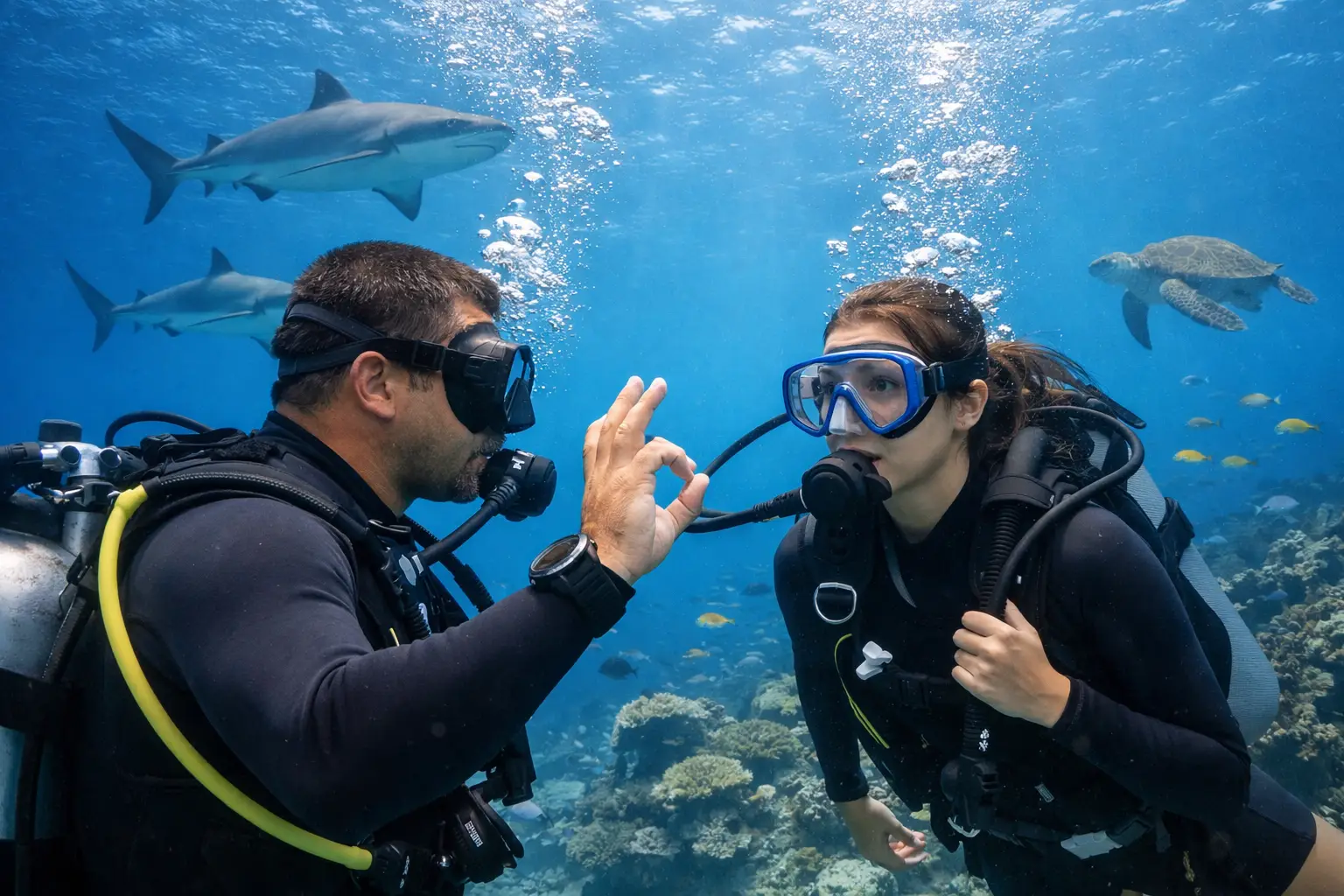
The moment your fins leave the bottom, scuba becomes less about equipment and more about control. The best beginner scuba skills help you stay relaxed, protect the reef, communicate clearly, and enjoy the remarkable details that less-prepared divers often miss.
A first-time diver does not need to be fearless, athletic, or naturally comfortable in deep water. They do need patient instruction, well-maintained equipment, and enough repetition to make essential responses feel familiar. In Fiji, that confidence opens the door to bright coral gardens, schooling fish, dramatic walls, and eventually, for properly trained divers, world-class shark encounters conducted with disciplined procedures.
The Best Beginner Scuba Skills Start With Control
The most useful skills are not necessarily the ones that look impressive on a certification checklist. They are the skills that prevent small discomforts from becoming stressful moments. Good instructors teach them in calm water first, then help students apply them in real conditions at a comfortable pace.
Breathe slowly and continuously
Scuba breathing should be steady, unhurried, and never held. New divers often take short, quick breaths when they are excited or trying to conserve air. That usually has the opposite effect: it can make a diver feel tense, increase air use, and make buoyancy harder to manage.
A long, relaxed exhale is especially valuable. It helps settle your body and gives you finer control of your position in the water. If you feel rushed, pause near your buddy, check your breathing, and let the rhythm slow down before moving on. You are not competing with anyone underwater.
Breathing continuously is also a core safety rule. Air expands as you ascend, so a diver must never hold their breath while rising. This is one reason every ascent should be slow, controlled, and monitored.
Find neutral buoyancy without using your hands
Neutral buoyancy is the ability to hover at a chosen depth without sinking or floating upward. It is one of the defining scuba skills because it affects nearly everything else: comfort, air consumption, visibility, reef protection, and how easily you can stay beside your buddy.
Beginners commonly add too much air to the buoyancy control device, then vent too much, then repeat the cycle. The better approach is to make small adjustments and wait a moment for your body to respond. Your lungs also work as a fine-tuning tool. A slightly deeper breath can lift you subtly; a longer exhale can bring you down gently.
Weighting matters, too. Too much weight forces you to carry extra air in your BCD and makes precise control difficult. A proper weight check with an instructor or dive professional is worth the time. Saltwater, exposure protection, tank type, and body composition can all change the amount of weight you need.
Clear a mask before it becomes a problem
A little water in a mask is normal, especially when smiling around a regulator or adjusting the seal. The skill is not avoiding every drop. It is knowing how to clear the mask without panic.
Keep your regulator in place, look slightly upward, press the top edge of the mask frame, and exhale gently through your nose. The air pushes water out through the bottom of the skirt. Practice makes this feel routine, and routine is what keeps a minor inconvenience from interrupting a great dive.
If a mask fully floods or comes off, stay close to the bottom or hold a stable position, signal your instructor or buddy, and use the method you practiced. There is no prize for rushing. Calm, deliberate steps are safer than fast ones.
Core Beginner Scuba Skills for Buddy Safety
Scuba is a team activity, even when a dive feels peaceful and personal. Your buddy is not just someone who appears in a photo. They are part of your safety system, and you are part of theirs.
Communicate early and clearly
Before entering the water, agree on the basic plan: maximum depth, expected time, direction, turn pressure, and what to do if you become separated. Underwater, use standard hand signals that are clear enough to understand at a glance.
The most important signal is often not “OK.” It is the signal for “not OK” or “something is wrong.” Use it promptly when you are cold, uncomfortable, low on air, unable to equalize, or simply unsure. A capable diver does not hide a problem to avoid slowing down the group.
Stay close enough to your buddy to communicate and assist each other, while leaving enough room to avoid accidental fin contact. Conditions determine the ideal distance. In clear, calm water, you may have more space; in current, lower visibility, or around sensitive coral, tighter positioning can be the smarter choice.
Check your air before it feels urgent
Beginner divers should make a habit of looking at their pressure gauge regularly, not only when an instructor asks. Air management is part planning and part awareness. Check your gauge at intervals, compare it with your buddy’s supply, and follow the agreed turn pressure.
Your air use will likely improve with experience, better buoyancy, and a calmer breathing pattern. But air consumption varies widely between people and dives. Water temperature, current, exertion, depth, and stress all play a role. The right goal is not to match another diver’s numbers. It is to stay informed and end every dive with an appropriate reserve.
Practice sharing air with purpose
An out-of-air drill can sound intimidating on land, but it is designed to make a rare event manageable. You learn to signal your buddy, locate and use their alternate air source, establish contact, and ascend together in control.
The key is practice under supervision until the sequence is familiar. Do not treat the drill as a performance. Its value comes from moving slowly enough to build the right habits: signal, secure a breathing source, stabilize, and follow the ascent plan.
Equalizing Is a Skill, Not a Test of Toughness
Pressure changes begin almost immediately on descent. To equalize, gently add air to the spaces in your ears and sinuses before discomfort builds. Many divers pinch the nose and blow lightly, while others swallow or move their jaw. Your instructor can help you find an approach that works well for you.
Equalize early and often. If you feel pain or pressure that will not clear, stop descending, rise slightly, and try again. If it still does not clear, end the descent. Forcing an equalization can cause injury, and no reef, wreck, or marine encounter is worth damaging your ears.
Congestion can make equalizing unpredictable. If you are sick, heavily congested, or relying on medication that may wear off underwater, speak honestly with a dive professional and consider sitting out the dive. Good judgment is a mark of a serious diver.
A Controlled Ascent Is Part of Every Great Dive
New divers can become so focused on what they see below that they forget the ascent deserves equal attention. Start upward with adequate air, remain with your buddy, and monitor your depth and rate throughout.
Ascend slowly, breathe continuously, and look upward for boats, swimmers, or overhead hazards. A safety stop, typically made near 15 feet for several minutes when conditions and the dive profile allow, adds a conservative margin after many recreational dives. Follow your instructor, guide, computer, and the plan for the day.
Your dive computer is a valuable tool, but it does not replace awareness. Learn what its alarms, no-decompression information, ascent-rate display, and safety-stop prompts mean before relying on it in open water.
Buoyancy Is Also Reef Etiquette
A healthy reef is alive with fragile structure. A single careless kick, dangling gauge, or hand placed on coral can cause damage that lasts far longer than a dive. Strong buoyancy and trim let you observe marine life without becoming an unwanted disturbance.
Keep your equipment streamlined. Secure alternate air sources, pressure gauges, cameras, and accessories so they cannot drag across the bottom. Use gentle fin movements and maintain enough distance to avoid touching coral, sand, or animals. Even resting on what appears to be bare substrate can disturb small creatures or delicate growth.
This matters especially in coral-rich destinations such as Pacific Harbour, where responsible divers have the privilege of seeing thriving marine ecosystems up close. Conservation is not separate from the adventure. It is how the adventure remains possible.
Build Skills in the Right Order
A beginner does not need to rush toward challenging depths, strong currents, or advanced wildlife dives. The strongest pathway is progressive: become comfortable with equipment handling and buoyancy, gain experience in varied but appropriate conditions, then add specialty training and more demanding environments as your confidence and judgment grow.
At Coral Coast Divers, SSI training is built around that progression, with professional guidance that gives new divers time to practice rather than simply complete tasks. A good course should leave you curious, capable, and aware of where experience still needs to grow.
Keep practicing the fundamentals on every dive, including easy ones. Hover during a safety stop, check your air without being prompted, review hand signals with your buddy, and choose the calm response when something feels unfamiliar. Those quiet habits are what turn a first certification into the beginning of a lifetime of responsible underwater adventure.