
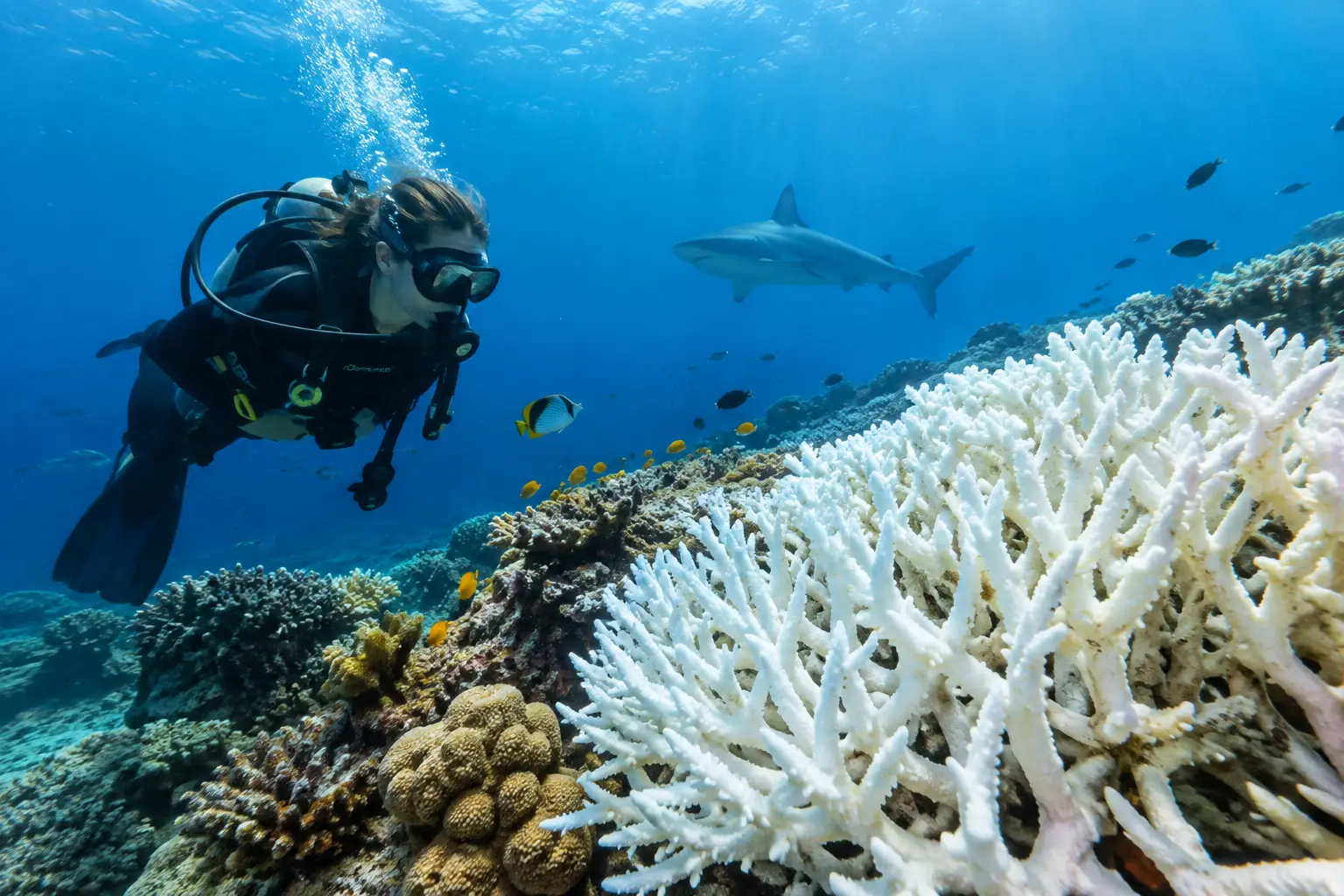
A reef can look healthy from the boat, then reveal its stress the moment you descend. Coral bleaching is one of the clearest signs that the conditions supporting a reef are under pressure. For divers, it is more than a conservation headline. It changes the color, behavior, and long-term future of the underwater places we travel across the world to experience.
In Fiji, reefs are not scenery around a dive site. They are living habitat for reef fish, turtles, invertebrates, and the larger species that depend on a functioning food web. Understanding what bleaching means helps divers make better choices before, during, and after a trip – and appreciate why careful marine stewardship belongs alongside every exceptional underwater encounter.
What Coral Bleaching Actually Means
Corals are animals, but their vivid greens, golds, pinks, and browns usually come from tiny algae living within their tissues. These algae, often called zooxanthellae, use sunlight to produce energy and provide much of the food corals need to grow. In return, the algae receive shelter and nutrients.
When water becomes too warm for too long, that relationship can break down. Corals expel the algae or the algae lose their pigments, exposing the coral’s pale calcium carbonate skeleton beneath translucent tissue. The result is the white or washed-out appearance known as coral bleaching.
Bleached coral is alive, but it is under severe stress. Without its primary energy source, it has less capacity to grow, reproduce, resist disease, or recover from physical damage. If favorable conditions return soon enough, some corals can regain their algae and color. If heat stress continues, bleaching can become mortality.
Why Coral Bleaching Happens
Elevated ocean temperature is the leading cause of widespread bleaching. A change of only a few degrees above a coral’s usual seasonal maximum can be enough to trigger stress, especially when unusually warm conditions persist for weeks. Marine heat waves are becoming more frequent and intense, leaving less recovery time between events.
Heat Is the Main Driver, But Not the Only One
High sunlight can worsen heat stress in shallow, clear water. Low tides, sediment runoff, nutrient pollution, disease, and poor water quality can also weaken corals before a warm-water event arrives. That is why two nearby reefs may respond differently during the same season.
A healthy reef is not invulnerable, but it has a better chance of recovery. Strong water flow, intact fish populations, limited pollution, and a wide variety of coral species all contribute to resilience. Some corals naturally tolerate heat better than others, while others grow quickly but are more vulnerable when temperatures spike.
Bleaching Does Not Look the Same Everywhere
Divers may picture bleaching as a completely white reef, but early stages can be less obvious. Corals may appear faded, fluorescent, pastel, or unusually pale compared with neighboring colonies. Some species bleach rapidly while others hold their color longer. A reef can also show a patchwork pattern, with healthy coral beside bleached colonies only a few fin kicks away.
This variation is not a reason for complacency. It is a reminder that coral reefs are complex ecosystems, shaped by temperature, depth, current, species, and the local pressures people can influence.
What Divers Can See Below the Surface
A bleached reef can still be full of life. Fish may continue feeding, schooling, cleaning, and sheltering among corals that have lost their color. That can make the issue easy to misunderstand. The reef has not necessarily died, but its foundation may be less stable than it appears.
On a healthy reef, hard corals provide structure: ledges for juvenile fish, refuge from predators, surfaces for invertebrates, and complex spaces that support biodiversity. When prolonged bleaching kills coral, algae can occupy the newly exposed space. Recovery is possible, but it is rarely quick and never guaranteed.
Experienced divers can observe without becoming intrusive. Look for changes in color and coral cover over the course of a dive, but avoid touching, hovering too close, or using a reef as a handhold for a photograph. Good buoyancy is conservation in action. A single fin strike may not cause a bleaching event, but physical damage adds stress to organisms already facing difficult conditions.
Coral Bleaching and Reef Recovery
Recovery depends on timing. If water temperatures cool before a coral’s energy reserves are depleted, surviving tissue may take back algae from the water column or rebuild its partnership with remaining algae. Color can return gradually, sometimes over months. A coral may look recovered before it has fully regained its former growth rate or reproductive capacity.
The larger reef needs more than individual corals to survive. It needs herbivorous fish to keep algae in check, enough healthy coral nearby to produce larvae, and clean conditions where young corals can settle. This is why marine protection, fisheries management, wastewater treatment, and climate action all matter together. Coral planting can support targeted restoration, but it cannot substitute for reducing the warming and local stressors that caused the damage.
For visitors, this is a useful distinction. Restoration is valuable when it is science-led, site-specific, and supported over time. The strongest conservation model also protects existing healthy reef, improves local resilience, and reduces avoidable harm before corals need intervention.
How Responsible Divers Can Help
Every diver has a role, particularly at popular reefs where repeated small impacts can accumulate. Choose operators that brief guests clearly, maintain appropriate group control, and treat the reef as a protected environment rather than a backdrop. At Coral Coast Divers, conservation awareness is part of the dive experience because safety, reef etiquette, and quality encounters are closely connected.
Before entering the water, secure gauges, cameras, alternate air sources, and accessories so nothing drags across coral. Practice neutral buoyancy away from the reef, descend and ascend with control, and keep a respectful distance even when currents make positioning more challenging. If conditions exceed your comfort or experience level, say so. A professional guide can adapt the plan, and choosing not to force a dive is good judgment.
Photography deserves the same discipline. Get the shot through patience and positioning, not by touching coral, chasing marine life, or asking a guide to manipulate an animal for the camera. Reef-safe sun protection can help reduce chemical pollution, but physical protection such as rash guards, shade, and covering up is often the simplest approach.
Travel choices matter above the surface, too. Support operators that invest in marine education, follow established safety standards, limit environmental impact, and contribute to meaningful conservation work. Ask informed questions about how a business manages anchors, waste, fuel, visitor behavior, and reef access. Responsible tourism is not passive. It is a decision to direct travel spending toward the places and practices that protect what visitors came to see.
A Better Way to Experience a Changing Reef
Witnessing bleaching can be emotional, especially for divers returning to a favorite site. The right response is neither denial nor the belief that every reef is already lost. Many reefs retain remarkable capacity to recover when conditions improve, and informed visitors can be part of protecting that potential.
Take the time to notice the details on every dive: healthy coral recruits, grazing fish, current patterns, and the small interactions that show a reef is functioning. Those observations build a deeper kind of adventure – one rooted not only in what a reef gives us, but in the responsibility to leave it with a better chance to endure.