
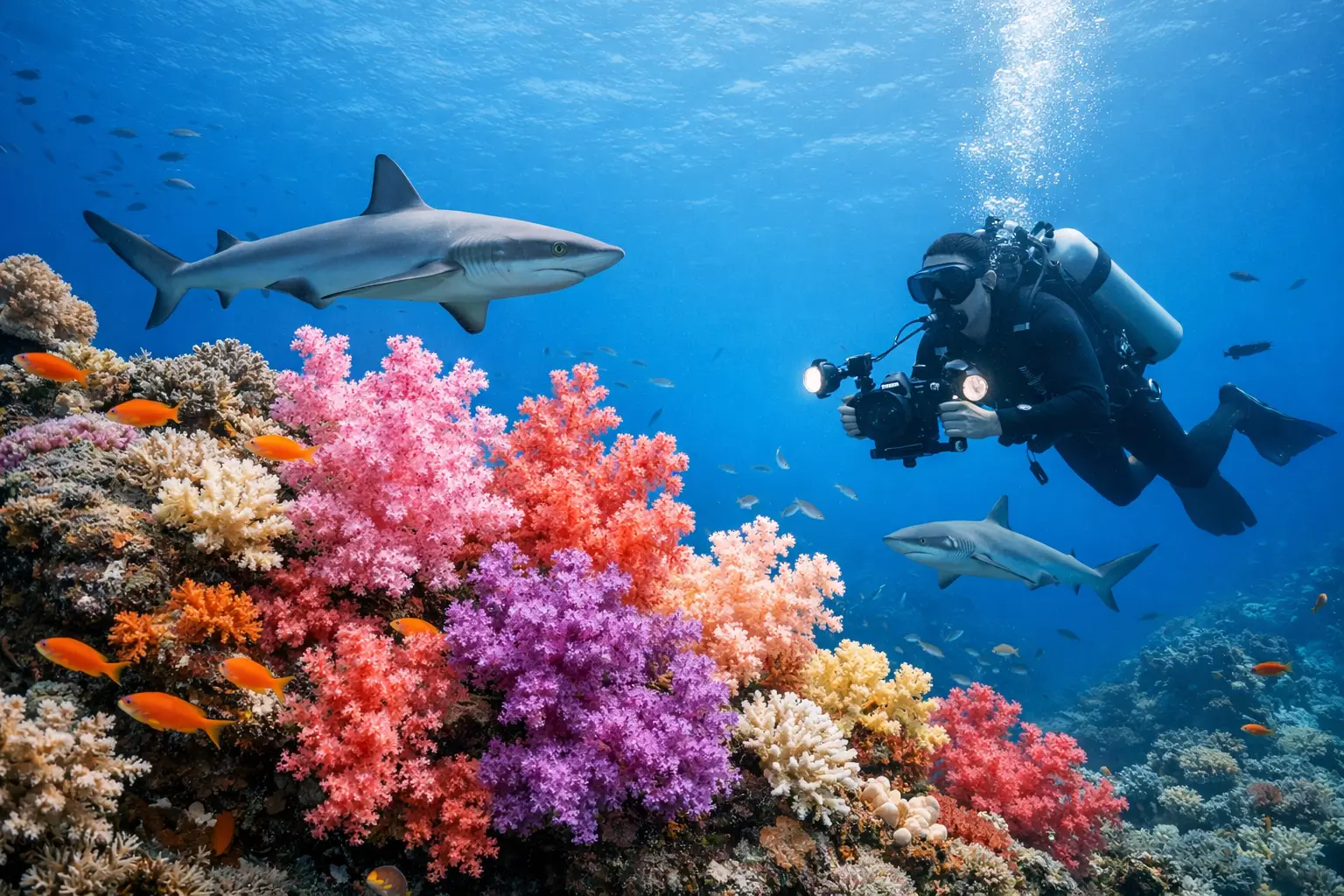
One of the fastest ways to feel more at home underwater is to stop seeing a reef as a blur of color and start recognizing who is actually there. Soft coral reef identification gives you that shift. Instead of labeling everything as “coral,” you begin to notice tree-like colonies, waving hands, leathery lobes, and delicate polyps that open and close with light and current.
For divers, that skill does more than make a dive feel richer. It sharpens buoyancy awareness, improves underwater photography, and deepens respect for reef health. If you can identify soft corals with reasonable confidence, you are reading the reef rather than just passing through it.
What makes soft corals different?
Soft corals are cnidarians, like hard corals, but they do not build the large rigid limestone skeletons that create classic reef framework. Instead, they are supported by tiny internal skeletal elements called sclerites, along with flexible tissue that allows many species to bend with surge and current.
That flexibility is the first clue. Hard corals often look stony, fixed, and architectural. Soft corals tend to look fleshy, branching, feathery, fingered, or leathery. On a live reef, they often appear to sway, fold, or pulse in moving water.
That said, underwater identification is rarely perfect on the first pass. Lighting changes color, depth changes contrast, and current can make one species look like another. Good identification is less about memorizing every name and more about learning a repeatable way to observe.
Soft coral reef identification starts with form
The easiest place to begin is colony shape. Before you think about species, ask what overall structure you are seeing.
Some soft corals grow like bushes or small underwater trees, with many branches coming off a central stalk. Others form broad lobes or thick encrusting mats that spread over rock. Some resemble fingers reaching upward, while others look like folded leather or a cluster of tiny clubs.
This is why experienced guides often identify the group first and the exact species second. A diver who recognizes “branching soft coral” or “leather coral” is already far ahead of someone relying only on color.
Tree-like soft corals often belong to groups that use height to access current. Finger-like forms can be stout and compact or long and delicate. Leather corals usually have a thicker, smoother body with polyps emerging from the surface. If a colony looks like a flexible mushroom cap, a hand, or a set of rounded lobes, you are likely in leather coral territory.
Look closely at polyp arrangement
Once you have the shape, the next clue is the polyps. Polyps are the tiny living units that make up the colony, and their spacing and appearance matter.
On some soft corals, polyps are extended and obvious, giving the colony a fuzzy or flowered look. On others, they retract, leaving a smoother surface with small bumps or pores. This can make the same colony look dramatically different from one moment to the next.
That is where patience helps. If current is moderate and the coral is undisturbed, pause and watch. Are the polyps evenly distributed across the surface, concentrated on branch tips, or arranged in rows along the sides? A colony with densely packed, feathery polyps reads differently than one with sparse, larger polyps on thick fingers.
For photographers, this is also a useful reminder not to identify from a single cropped image. A macro shot of polyps may miss the colony shape, while a wide shot may hide the surface detail that separates one group from another.
Color helps, but only up to a point
New divers often try to identify coral by color first. It is understandable, but it is also unreliable.
Soft corals can be cream, tan, brown, pink, orange, yellow, purple, or red. Underwater, depth quickly removes warm tones, and camera settings or torch light can exaggerate them. Two different species may appear nearly identical in blue ambient light, while the same species can look very different at 20 feet versus 80 feet.
Color is still useful when combined with form and texture. A bright yellow branching colony with fine polyps tells you more than “yellow coral.” A purple leather-like colony with broad lobes and a smooth surface tells you more than “purple soft coral.” Use color as a supporting clue, not the main one.
Habitat is part of soft coral reef identification
Where a coral grows can narrow the possibilities fast. Soft corals are not placed randomly across a reef. Many favor areas with stronger current because moving water brings food and helps clear sediment. Others do better on sheltered slopes, walls, or lagoon patch reefs.
If you are on an exposed site with steady current, it makes sense to expect more flexible, branching, current-adapted forms. If you are in a calmer area with silty conditions, you may see species better suited to periodic sediment load or lower water movement.
Depth matters too. Some soft corals thrive in shallower, brighter zones. Others become more common as you move deeper along a wall or slope. This is one reason local knowledge matters so much. Reef identification improves quickly when you connect what you see with site conditions rather than treating every coral as if it could appear anywhere.
Common soft coral groups divers notice first
Most recreational divers do not need to become taxonomists to improve their ID skills. It is more practical to recognize a few broad categories well.
Leather corals are among the most approachable. They usually have a thicker body and can appear as discs, folds, hands, or broad lobes. When polyps are retracted, they may look almost waxy. When extended, the surface becomes textured and alive.
Finger corals and club-shaped soft corals are another common visual group. These grow in upright projections and can range from short and blunt to tall and slender. They are often easier to spot on reef slopes where shape is clear against open water.
Branching, tree-like soft corals are favorites for wide-angle scenes because they add height and structure. In current, they create that classic sense of motion many divers remember long after the dive.
Sea fans and sea whips are often discussed alongside soft corals in casual conversation, though some belong to closely related octocoral groups that divers may separate only at a more advanced level. For practical field recognition, many divers start by noting fan-shaped versus whip-like growth and then refine from there.
The mistakes divers make most often
The biggest mistake is rushing. A quick glance rarely gives enough information. If conditions and safety allow, take five extra seconds. Look at the whole colony, then the surface, then the surrounding habitat.
The second mistake is confusing sponges, hydroids, and tunicates with soft corals. Sponges can be bright and branching, but they lack the visible polyp structure of soft corals. Tunicates may form colorful masses but usually have a very different texture and opening pattern. Hydroids can look feathery, yet their colonies are usually finer and more delicate than most soft corals.
The third mistake is trying to force a species-level ID without enough evidence. There is no shame in stopping at family or growth form. In fact, that is often the most honest field identification a diver can make.
How to get better on your next dive
Improvement comes from using the same observation sequence every time. Notice the overall shape first, then check texture, then look for polyp pattern, then factor in color and habitat. Over a few dives, your brain starts building categories naturally.
It also helps to choose one target per dive. Maybe today you focus only on leather corals. On the next dive, compare branching forms in high-current areas. Trying to learn every coral at once usually leads to frustration.
If you dive with a guide or marine naturalist, ask them what features they use first. The best underwater observers are not necessarily the ones with the longest species list. They are the ones who know what to ignore and what to trust.
For anyone diving Fiji’s reef systems, this is especially rewarding. Reefs with strong fish life, changing topography, and healthy soft coral cover offer ideal conditions for building recognition skills while still enjoying the bigger spectacle. At Coral Coast Divers, we see this often – guests arrive focused on sharks or dramatic reef scenes, then leave noticing coral forms and reef relationships they had never picked up before.
Why identification matters beyond curiosity
Learning coral ID changes how you move underwater. Divers who can read the reef tend to keep better distance, make better photo decisions, and avoid careless contact. Identification builds attention, and attention improves reef etiquette.
It also supports conservation in a practical way. You do not need a science degree to notice when a reef looks different from the last visit, when polyps are not extending normally, or when sediment seems to be affecting a certain zone. Better observers become better advocates.
That is the real value of soft coral reef identification. It turns a beautiful background into a living community with patterns, personalities, and warning signs. Once you start seeing those details, every reef becomes more interesting, and every dive asks a little more of your awareness in the best possible way.