Most divers remember their first bull shark encounter in vivid detail – the heavy build, the direct movement, the unmistakable presence. What often surprises people is not aggression, but composure. Bull shark behavior explained properly looks very different from the version shaped by headlines. In the water, these sharks are powerful, highly aware animals responding to habitat, food cues, body language, and energy in ways that are far more predictable than many people assume.
For divers, that distinction matters. Understanding behavior changes the experience from anxious guesswork to informed observation. It also leads to better decision-making, stronger respect for the animal, and safer interactions under professional supervision.
Bull shark behavior explained: what makes this species different
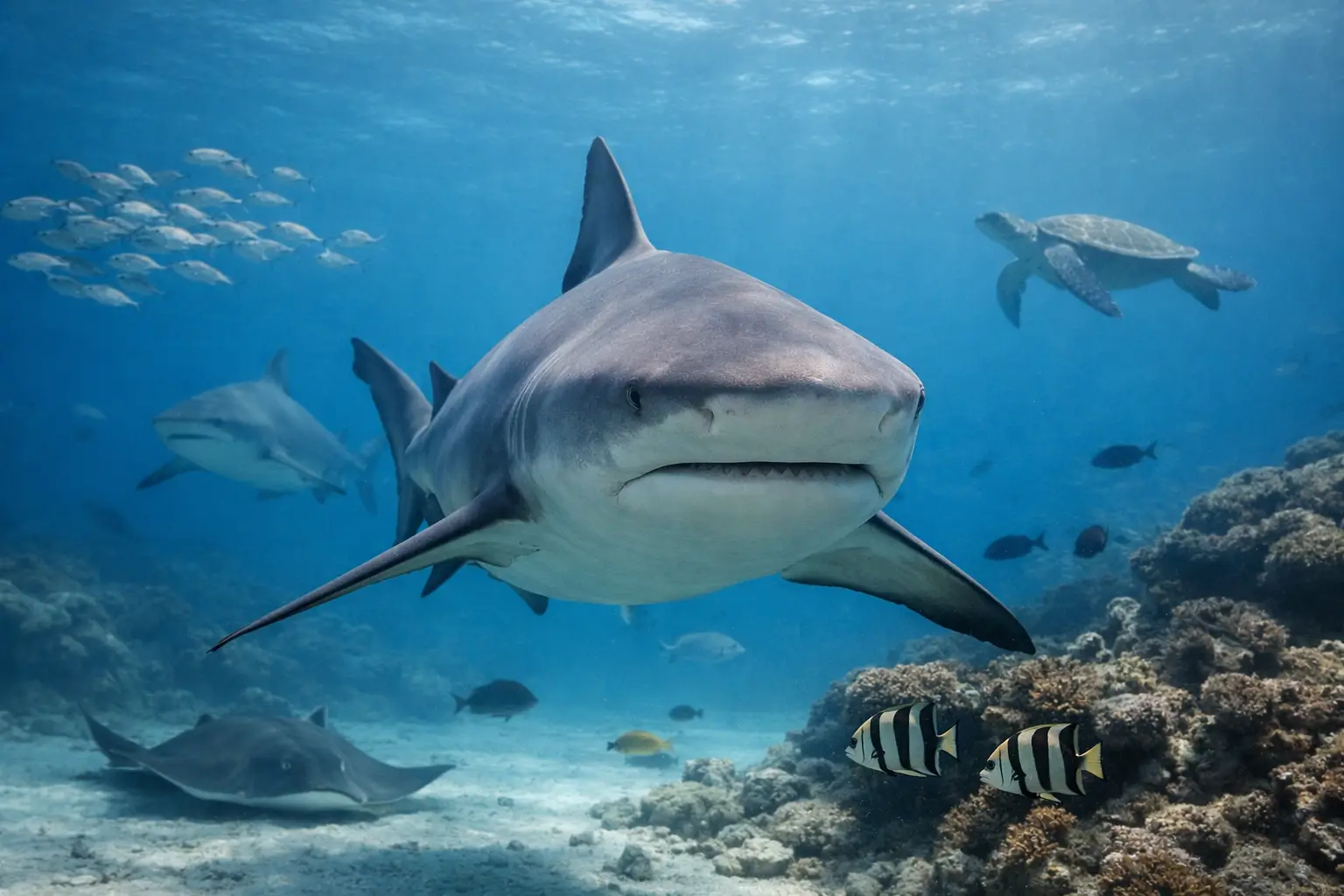
Bull sharks are built for authority. They have a stocky body, a blunt snout, and a swimming style that can look more deliberate than fast. That deliberate movement is part of why they command attention. They do not need to rush to appear dominant in a space.
One reason bull sharks stand apart from many other species is their tolerance for both saltwater and freshwater. They can travel into estuaries, river mouths, and low-salinity environments, which brings them into a wider range of habitats than many oceanic sharks. That flexibility affects behavior. A bull shark is not tied to one narrow ecological zone, so its feeding opportunities and movement patterns can be broad.
They are also strongly sensory-driven. Like other sharks, they rely on smell, hearing, lateral line vibration detection, and electroreception. But in murkier coastal water, those non-visual senses become especially important. A diver watching a bull shark pass at close range is often seeing an animal assess the area through multiple channels at once, not simply “looking” in the way a human would.
That is why behavior can appear intense even when it is not overtly aggressive. A close pass, a sudden turn, or repeated circling may be investigation rather than attack. Context is everything.
How bull sharks read their environment
Bull sharks are opportunistic predators. That does not mean reckless. It means they are efficient. They respond to available food sources, water conditions, competition, and movement in the environment.
In coastal systems, visibility, current, and prey density can all shape how they behave. In lower visibility, a shark may make closer investigative passes because it is gathering information. In areas with active baitfish, reef fish, or other feeding activity, movement can become more purposeful. During structured shark dives, trained guides account for these variables carefully because shark behavior is never separate from the conditions around it.
Body posture also tells a story. A calm bull shark often moves with steady rhythm and controlled spacing. An arched back, exaggerated pectoral fin positioning, sharper directional changes, or more abrupt motion can signal heightened stimulation. None of these signs should be interpreted in isolation, but experienced professionals read them together.
This is one reason shark diving is not just about getting close. It is about reading the water correctly.
Why bull sharks sometimes seem unpredictable
Bull sharks have a reputation for unpredictability partly because they inhabit dynamic environments. River mouths, coastal drop-offs, channels, and reef edges are places where visibility, salinity, current, and prey activity can shift quickly. When the environment changes fast, behavior can look sudden to an observer.
There is also a human bias involved. People often label an animal unpredictable when they do not understand the signals leading up to a behavior. A bull shark accelerating, changing depth, or angling in for a closer pass may be responding to scent, vibration, hierarchy around food, or another shark nearby. To a trained team, those actions often fit a readable pattern.
That does not mean every moment can be controlled. Wild animals are still wild animals. Good shark operations respect that reality rather than pretending every encounter follows a script. The goal is not certainty. The goal is disciplined risk management built on species knowledge, site familiarity, and diver behavior standards.
Bull shark behavior around divers
Most bull sharks do not view divers as natural prey. In supervised settings, they are typically responding to novelty, structure, or established feeding cues rather than targeting humans as food. That said, they are large apex predators, and complacency has no place in the water.
Divers influence shark behavior more than many realize. Erratic kicking, rapid ascents, reaching out, chasing for photos, or drifting out of position can alter the interaction. Calm posture, controlled breathing, stable buoyancy, and attention to the guide all help keep the encounter orderly.
Bull sharks are especially responsive to confidence and consistency in the environment. A well-managed group tends to produce more stable interactions than a chaotic one. This is why serious shark diving operators emphasize briefing quality, positioning, and in-water discipline. The experience becomes better not by acting fearless, but by acting trained.
For photographers and videographers, the trade-off is familiar. The closer and more dramatic the shot you want, the more important restraint becomes. Overcommitting for one frame can disrupt the entire scene and reduce safety margins for everyone.
Feeding behavior and competition
Bull sharks are not constant eating machines, despite the stereotype. Like all predators, they balance energy use with opportunity. They may feed on fish, rays, smaller sharks, crustaceans, and whatever prey is practical in a given habitat.
Competition affects behavior significantly. Where multiple sharks are present, spacing can tighten, speed can increase, and body language can become more assertive. This does not automatically mean danger is escalating, but it does mean the social energy in the water has changed. Experienced dive teams pay close attention to those shifts.
Feeding-related behavior is also where public misunderstandings often grow. If someone sees sharper turns, faster approaches, or jostling between sharks, they may assume the animals are in a mindless frenzy. In reality, there is often a structure to the interaction. Individual sharks establish priority, test space, and respond to one another as much as to any food source.
Understanding that dynamic is central to safe shark diving. It is one thing to admire sharks from a distance. It is another to interpret how they behave when stimuli increase.
What divers should never assume
The biggest mistake is treating bull sharks as either monsters or pets. Both views are equally unhelpful.
When people see sensational media, they may assume every bull shark encounter is on the edge of disaster. That mindset creates tension, and tension leads to poor choices. On the other side, people who have several calm dives may start treating sharks as fully predictable. That mindset can breed carelessness.
The truth sits in the middle. Bull sharks are intelligent, adaptable predators with recognizable behavioral patterns. They can be observed safely in the right conditions with the right protocols. But they always deserve space, respect, and professional oversight.
That middle ground is where the best shark encounters happen. Not in fear, and not in fantasy.
Bull shark behavior explained for shark dive guests
If you are preparing for a shark dive, the most useful thing you can bring is not bravado. It is discipline. Listen closely to the briefing. Understand your position in the group. Keep your movements economical. Maintain awareness not only of the shark in front of you, but of the wider scene.
At premium shark diving sites, the goal is to create an experience that is exhilarating without becoming disorderly. That requires skill from the operation and cooperation from the diver. At Coral Coast Divers, that philosophy is central to how shark encounters are approached – not as thrill rides detached from reality, but as structured wildlife experiences grounded in training, site knowledge, and respect for the animals.
For newer divers, there is often a question beneath the excitement: will I know what to do if a shark comes close? In a properly supervised environment, yes – because close passes are expected, briefings are specific, and your role is simple. Stay calm, stay in position, and follow the guide. Predictability on the diver side helps keep predictability on the shark side.
For experienced divers, the challenge is often different. Familiarity can make people casual. The best advanced divers do the opposite. They stay sharp, read subtle changes, and understand that confidence underwater should look quiet.
Why understanding behavior supports conservation
When people learn how bull sharks actually behave, fear tends to give way to respect. That matters beyond the dive itself. Species that are misunderstood are easier to demonize, and species that are demonized are harder to protect.
Bull sharks play a real ecological role in maintaining balance in marine systems. As apex predators, they influence prey behavior and help shape food-web stability. Removing them affects more than one species. It changes how entire ecosystems function.
Responsible shark tourism can help bridge the gap between public fear and scientific reality. Done well, it gives people a direct experience with an animal they may have only known through misinformation. It also creates economic value around keeping sharks alive, which is one of the strongest arguments for long-term protection in coastal communities.
The more clearly we understand bull sharks, the less room there is for myth. And once you see their behavior for what it is – calculated, responsive, and deeply tied to the environment – the encounter becomes even more remarkable.