
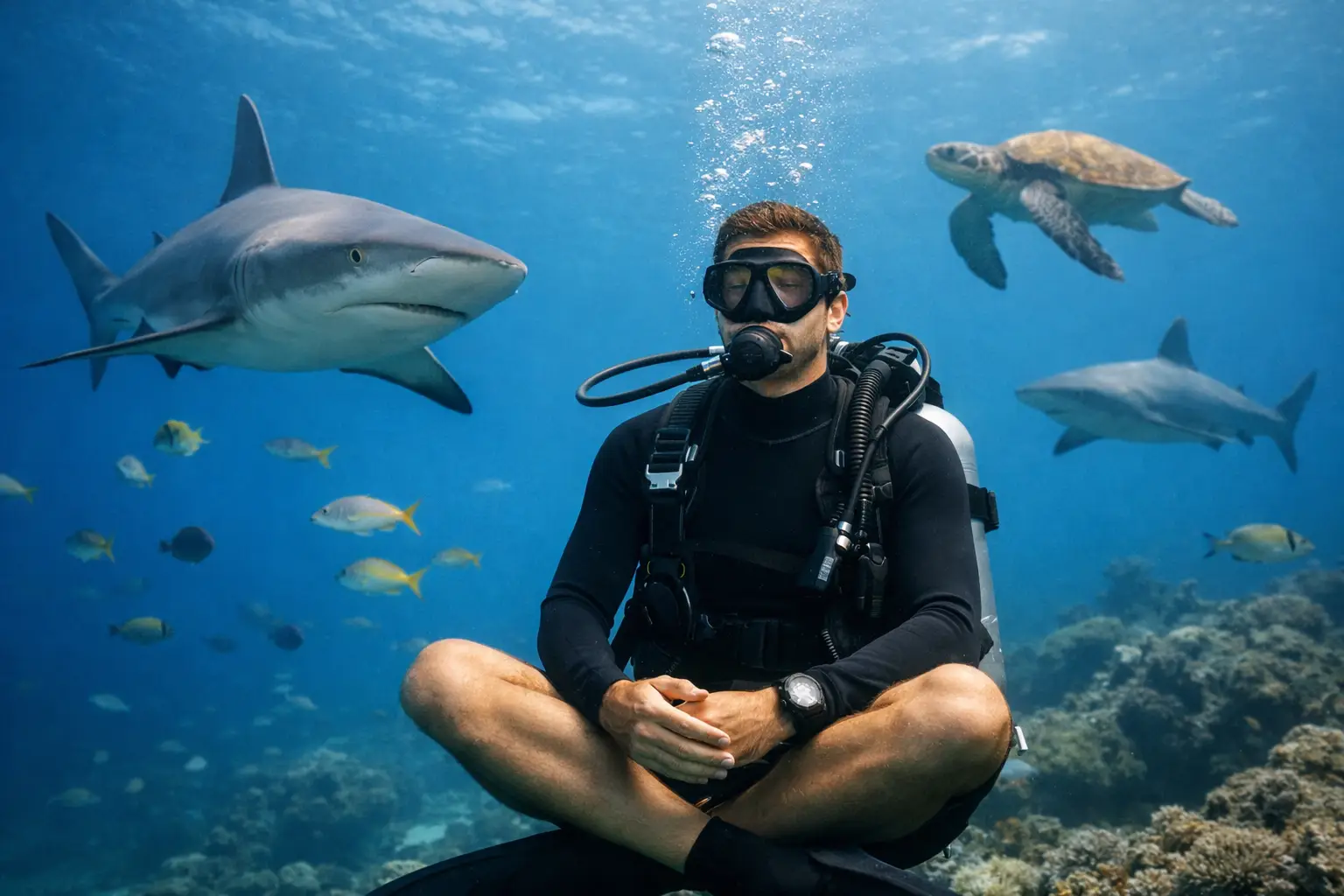
The moment your breathing gets loud in your regulator, everything underwater can feel bigger than it is. A mild current feels stronger. A simple mask issue feels urgent. Even a routine descent can start to feel rushed. If you want to know how to stay calm underwater, the goal is not to force yourself to feel fearless. The goal is to recognize stress early, slow your reactions, and return to controlled breathing and deliberate movement.
That distinction matters whether you are new to scuba, returning after time away, or preparing for a high-impact experience like a shark dive. Calm divers use less gas, communicate more clearly, and make better decisions. They also enjoy the dive more, which is usually why they got in the water in the first place.
Why staying calm underwater changes everything
Underwater stress tends to build in a chain. A fast descent can lead to missed equalization. Missed equalization can create discomfort. Discomfort can trigger faster breathing, and faster breathing can make you feel as if something is seriously wrong even when the problem is still manageable.
That is why experienced dive professionals focus so heavily on the basics. Good trim, controlled breathing, clean weighting, and clear pre-dive planning are not just technical skills. They are stress prevention tools. When your setup feels balanced and your actions feel intentional, your brain has more room to assess the situation instead of reacting to it.
There is also a psychological side to calm. Most divers do not panic out of nowhere. They become task-loaded, overstimulated, or surprised. A diver who expects that stress can happen is usually better prepared to interrupt it.
How to stay calm underwater before you even descend
A calm dive usually starts on the surface. If you rush your gearing up, skip your checks, or enter the water mentally scattered, you bring that tension down with you.
Start by getting honest about your condition that day. If you are tired, dehydrated, cold, or anxious, that does not automatically cancel the dive, but it should change how you prepare. Build in more time. Review the plan carefully. Ask questions before you splash, not after you are already working to descend.
Equipment familiarity matters more than many divers admit. An unfamiliar BCD, a rental regulator with a different hose routing, or a new exposure suit can all add just enough friction to make you feel off. None of that is dramatic, but small distractions stack up. If you can, assemble your gear slowly, do a full buddy check, and mentally rehearse the first few minutes of the dive.
Surface breathing helps too. Take long, steady breaths before descent and avoid rapid, shallow breathing. The point is not to hyperventilate. It is to set a rhythm. Once that rhythm is established on the surface, it is easier to keep it underwater.
Breathing is the first fix
If you feel stress underwater, your breathing is usually the first place to look. A fast breath rate tells your body that something is wrong, even when the actual problem is minor. Slow, full inhales and relaxed exhales send the opposite message.
Think about exhaling completely. Many divers focus on taking a deep breath in, but the exhale is what often breaks the cycle of tension. A long exhale reduces the feeling of urgency and helps your body settle. You do not need a complicated technique. Inhale slowly, pause briefly if it feels natural, then exhale fully and without force.
This is also why overexertion becomes such a common trigger. If you are kicking hard, fighting your buoyancy, or trying to keep up with a pace that does not suit you, your breathing rate climbs fast. Good dive planning and appropriate pacing matter. Strong divers are not the ones who muscle through the water. They are the ones who move efficiently.
What a calm breathing pattern feels like
A calm diver usually sounds quiet through the regulator. The chest and shoulders stay relaxed. Finning is measured, not hurried. Your breathing does not have to be slow in an exaggerated way, but it should feel controlled enough that you can think clearly and scan your surroundings.
If that control starts slipping, stop kicking if conditions allow, hold your position, and reset your breathing before doing anything else.
Fix the small problem before it becomes a big one
One of the best answers to how to stay calm underwater is learning to treat problems as tasks, not threats. A little water in the mask, a slipping fin strap, a free-flowing second stage, or a missed equalization attempt can all feel intense if your brain labels them as emergencies immediately.
Instead, pause and identify the issue. Ask yourself what is actually happening right now. Then respond in sequence. If your mask leaks, clear it. If your ears are not equalizing, stop descending and try again. If you are negatively buoyant and dropping faster than planned, add air to your BCD and regain control before continuing.
This is where training pays off. Skills practiced in a controlled environment become available when stress rises. That is one reason quality instruction matters so much, especially for divers building toward more advanced experiences. Confidence is not bravado. It is familiarity backed by repetition.
Buoyancy and body position reduce anxiety fast
Divers often think calm is purely mental, but physical control makes a huge difference. Poor buoyancy can create constant low-grade stress because you are always correcting. You are kicking to stay off the reef, inflating and deflating too often, or struggling to hold a stop. That keeps your attention fragmented.
Neutral buoyancy gives you time. It lets you hover, think, signal, and solve problems without feeling as if the ocean is making every decision for you. The same goes for trim. A balanced, horizontal position reduces effort and improves control.
If you tend to feel anxious underwater, do not overlook weighting. Too much weight is a common cause of stress because it forces extra BCD inflation and increases exertion. Too little weight can create a different kind of frustration near safety stops or at the surface. Proper weighting is not glamorous, but it can change the entire feel of a dive.
Use your attention on purpose
Underwater calm is partly about where your mind goes. If your attention narrows too much, you can spiral into your breathing, your gas consumption, or the single thing that feels off. If your attention gets too scattered, you lose awareness of your buddy, depth, and environment.
The sweet spot is deliberate awareness. Check your breathing, then your depth, then your buddy, then the environment. Repeat. This kind of simple mental loop gives your mind a job. It prevents random worry from taking over.
For some divers, visual focus helps. Look at a fixed point like a coral head, mooring line, or your guide’s fins while you reset your breathing. For others, tactile cues work better. Feeling one hand lightly on your inflator hose or clasped calmly at your chest can stop unnecessary fidgeting.
There is no single method that works for everyone. The key is to have one before you need it.
When shark diving, calm matters even more
Large animals amplify emotion. That is part of the appeal, but it also means anticipation can spike before the dive even begins. In a well-run shark dive, structure is your ally. Briefings, positioning, spacing, and guide signals are designed to reduce uncertainty and help divers stay focused.
If you are preparing for a premium shark experience in Pacific Harbour, calm comes from trusting the process and respecting the briefing. You do not need to perform confidence. You need to stay observant, maintain your position, and follow instructions precisely. Excitement is normal. Rushing, over-finishing, or breaking formation because you want a better view is where stress and poor decisions start to creep in.
This is also where conservation-minded diving changes the mindset. When you view the encounter as a structured wildlife experience rather than a thrill challenge, your behavior becomes steadier. You pay attention to the animals, the team, and your own control.
Know when to abort the dive
Real calm includes the willingness to stop. If your ears will not equalize, if your breathing does not settle, if you feel disoriented, or if something about your gear is not right, ending the dive can be the smartest move available.
That is not failure. It is good judgment. Strong divers are not the ones who ignore warning signs. They are the ones who respond early, communicate clearly, and protect the rest of the dive day.
At Coral Coast Divers, that mindset is built into the way serious diving should work. World-class underwater experiences depend on skill, planning, and respect for the environment, not pressure to push through discomfort.
Practice calm in easier conditions first
If staying calm underwater is a challenge for you, practice where the stakes feel lower. Work on hovering in shallow water. Clear your mask until it feels routine. Pause during a descent and reset your breathing on purpose. The more often you rehearse control, the easier it is to access under pressure.
Calm is not a personality trait that some divers have and others do not. It is a skill set, and like any diving skill, it improves with quality instruction, repetition, and trust in the fundamentals. The ocean rewards that kind of discipline. When you slow down enough to breathe well, move well, and think well, the underwater world tends to open up in a very different way.