
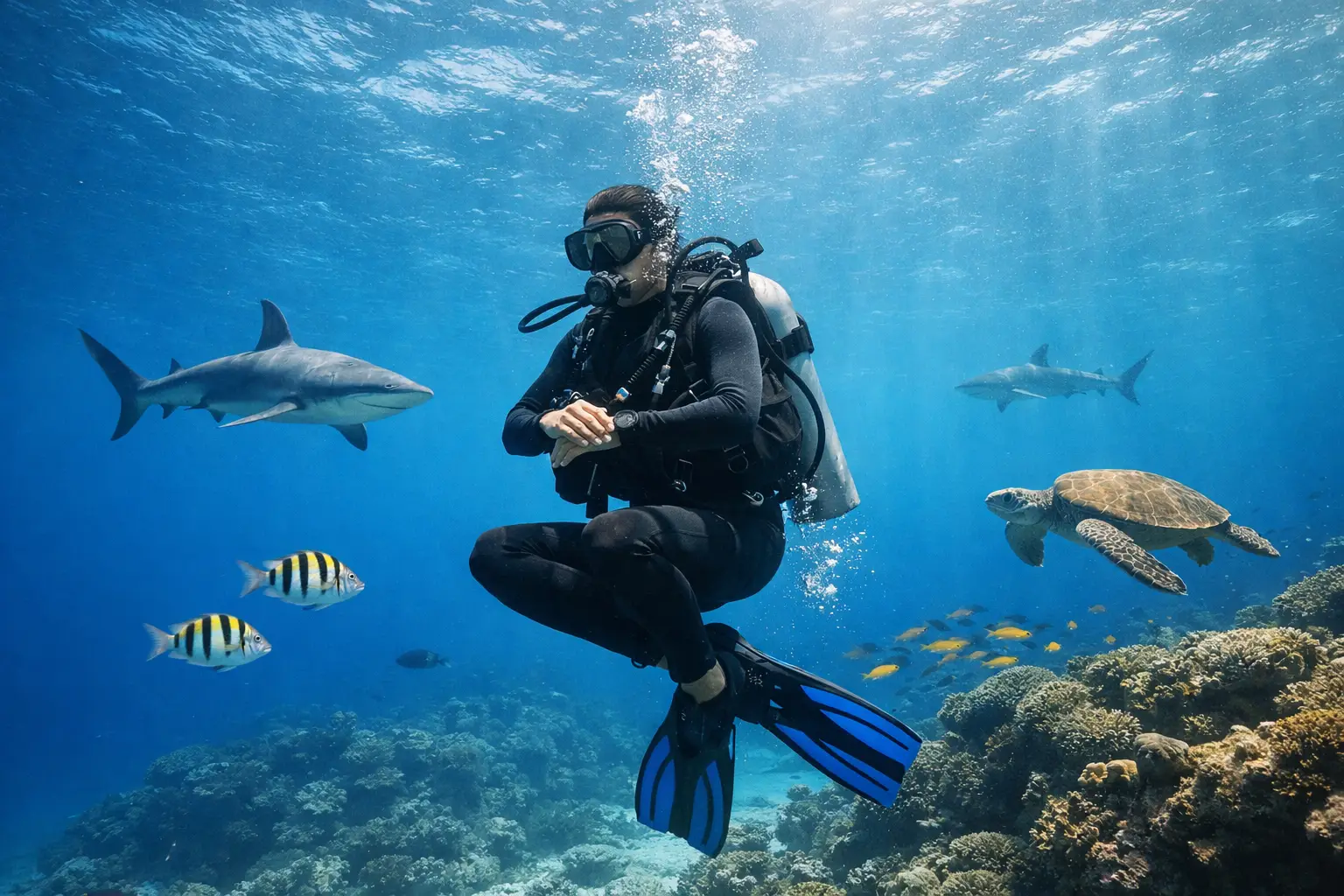
A diver who can hover motionless a few feet off the reef is not showing off. They are protecting the site, using less gas, staying calmer, and moving through the water with real control. If you want to know how to improve scuba buoyancy, start by thinking of it as a core dive skill, not a minor adjustment. Good buoyancy changes everything from air consumption to safety stops to how close you can get to marine life without disturbing it.
Buoyancy is also one of the clearest differences between a diver who is simply certified and a diver who is truly comfortable underwater. On high-action dives, including shark sites where positioning and awareness matter, solid buoyancy is not optional. It lets you stay where you need to be without kicking the bottom, drifting into other divers, or constantly inflating and dumping air to chase control.
How to improve scuba buoyancy starts before you descend
Most buoyancy problems begin at the surface. Divers are often carrying too much weight, wearing poorly balanced gear, or entering the water already tense. Then the dive turns into a cycle of overcorrecting.
The first fix is proper weighting. If you are overweighted, you will add extra air to your BCD to compensate, and that larger air bubble becomes harder to manage as depth changes. Small depth shifts create bigger buoyancy swings, and the dive can feel unstable from start to finish. If you are underweighted, you may struggle to descend or hold a safety stop, especially with a nearly empty tank. Both problems can look like bad buoyancy, but they are really setup issues.
A proper weight check should happen with the exposure protection, tank type, and conditions you are actually diving in. Salt water, aluminum cylinders, thicker wetsuits, and changing body composition all affect what you need. There is no perfect number that follows you everywhere.
Trim matters just as much. If your tank is too low, your fins may drop. If weight is concentrated in the wrong place, your torso may tilt up or down. That awkward angle creates drag and makes buoyancy feel worse than it is. A diver in flat, balanced trim usually finds buoyancy easier because the body moves through the water naturally rather than fighting it.
Breathing is your real buoyancy control
Your BCD gets you close. Your lungs do the fine-tuning.
This is where many divers get stuck. They know they should “breathe normally,” but underwater that advice can feel vague. In practice, better buoyancy comes from slow, relaxed, complete breaths. When you inhale, you become slightly more buoyant. When you exhale, you become slightly less buoyant. That change is enough to rise or settle by inches, which is exactly the level of control most divers need.
The mistake is treating breathing like a panic switch. If you hold your breath, buoyancy gets jerky and your stress usually rises with it. If you breathe fast and shallow, you lose the smooth rhythm that keeps you stable. A calm diver looks calm because they are breathing in a controlled pattern, not because they are doing anything dramatic with their gear.
One useful habit is to pause before adjusting your inflator. If you feel slightly low, take a slower, deeper breath and see whether that solves it. If you feel slightly high, a full exhale may bring you back into position. Not every buoyancy issue needs a BCD correction.
Use your BCD less, but use it better
A common sign of weak buoyancy control is constant button pushing. Add air, dump air, add air again. It works for a moment, then creates another correction.
A better approach is to make smaller, earlier adjustments. Add short bursts of air instead of long presses. Dump before a major ascent, not after you are already floating upward. Give the BCD a moment to respond before deciding it did not work. New divers often make a change and immediately make another one, which can turn a minor shift into a yo-yo profile.
Depth also matters. The shallower you are, the faster buoyancy changes. At 15 feet, even a small amount of expanding air can make you rise quickly. That is why buoyancy often feels manageable at depth and strangely difficult during the last part of the dive. You are not imagining it. The water column is less forgiving near the surface.
This is also why safety stops reveal the truth. If you can hold 15 feet without sculling your hands, bicycling your fins, or touching the line every few seconds, your buoyancy is improving.
Finning and body position can ruin good buoyancy
Some divers are weighted correctly and breathing well, but still feel unstable because their movement is working against them. Poor finning creates lift, drag, and unnecessary changes in depth.
If you kick downward hard, your upper body may rise and your trim can break apart. If you constantly use your hands to balance, you add even more instability. Efficient finning should move you forward, not bounce you up and down through the water column.
This is where slowing down helps. Many divers improve buoyancy the moment they stop trying to power through the dive. A measured pace gives you time to notice small depth changes, refine your breathing, and move with less effort. It also improves your gas consumption, which is rarely an accident.
Frog kicking can help because it encourages horizontal trim and reduces the chance of stirring up the bottom. Back finning and helicopter turns are even more useful on crowded sites, near coral, or when positioning carefully around marine life. These are not just advanced style points. They support buoyancy by reducing the need for large body movements.
How to improve scuba buoyancy during descent and ascent
The beginning and end of the dive are where most buoyancy errors stack up.
On descent, equalize early and often, but also start venting your BCD before you need to. If you wait too long, you may find yourself hanging at the surface, then suddenly dropping once enough air escapes. A controlled descent should feel deliberate. You are releasing air in stages, monitoring speed, and settling into neutral buoyancy as you approach depth.
On ascent, divers often focus so much on going slowly that they forget to manage expanding air. If you are rising and not venting, the ascent can accelerate. The skill is anticipation. As you come shallower, release small amounts of air before the BCD becomes overfull. Stay vertical only when it serves a purpose. In many situations, a slightly more horizontal position gives better control.
If your ascents tend to drift fast near the end, you may not need a radically different technique. You may simply need earlier venting and more awareness in the last 20 feet.
Practice buoyancy on easy dives, not just big ones
The best time to improve buoyancy is not during a bucket-list dive when the current is moving and your attention is split between photography, marine life, and staying with the group. It is on simple dives where you have space to focus on the basics.
Try hovering midwater for 30 seconds without finning. Then do it for a minute. Practice ascending a few feet using only your breath, then settling back down without touching your inflator. Swim at the same depth along a reef edge and notice what happens when your breathing speeds up. These drills sound modest, but they build the control that experienced divers rely on every day.
Video is useful here. Many divers are surprised by what they see – dropped knees, waving hands, head-up posture, or constant tiny kicks that feel normal in the moment. Honest feedback from a skilled instructor can shorten the learning curve fast.
If buoyancy has been a recurring frustration, a dedicated buoyancy or skills tune-up course is often worth more than another casual fun dive. A few focused sessions can clean up habits that have been costing you comfort and confidence for years.
Better buoyancy is also better for the reef
There is a personal reason to improve buoyancy, and there is an environmental one. Divers with poor control break coral, stir sediment, and stress marine life, usually without meaning to. Divers with refined control can approach a site with precision and leave almost no trace.
That matters on every reef, but especially in places where healthy ecosystems are part of the draw. In Pacific Harbour, Fiji, where dramatic reef structure and pelagic encounters can share the same day, buoyancy is not just about looking polished underwater. It is part of responsible diving. The less contact you make with the environment, the more natural the experience remains for both divers and the marine life that makes the site special.
There is no single trick that fixes buoyancy overnight. It gets better when your weighting is honest, your breathing is calm, your trim is balanced, and your movements are deliberate. Once those pieces start working together, the water feels bigger, quieter, and much easier to read. That is when diving becomes less about managing yourself and more about experiencing what is around you.